 to an admittedly simplistic but effective analogy of the Atonement presented by the Wesleyan Arminian blog.
Sunday, March 29, 2009
Arminianism vs. Calvinism
Here is a link to an admittedly simplistic but effective analogy of the Atonement presented by the Wesleyan Arminian blog.


Saturday, March 28, 2009
St. Augustine on the Church
“He cannot have God for his Father who will not have the Church for his mother.”
-St. Augustine
Marva Dawn on Church shopping
“We have turned churches into 'vendors of religious services and goods' where people shop for worship, instead of 'a body of people on a mission'. People choose a church by what makes them feel good, instead of belonging to a community in which God will kill us, and then raises us up into the new life of obedience!”
- Marva J. Dawn, Living in the Lamblight,
ed. by Hans Boersma
ed. by Hans Boersma
Tuesday, March 24, 2009
Sunday, March 22, 2009
Problems with "Contemporary worship"
I have often complained about "contemporary-style" worship, by which I refer to worship styles which generally utilize a "praise band" and newer "choruses" with words projected on a screen or wall, as opposed to organs, choirs, and traditional hymnody (I'm obviously painting with broad strokes).
Some complaints:
1) "Contemporary worship" is not contemporary. It is better termed "Baby Boomer-style" worship, since the Baby Boomer generation (those born in roughly 1945-1967) is the generation which created it. Post-Baby Boomers are creating and recapturing other styles; in fact, "contemporary" worship is really just worship that was contemporary 30 years ago, as opposed to 500+ years ago (as with "traditional" worship). It's no more contemporary than Gregorian chant, and we ought to stop referring to it as such.
2) Baby Boomer worship is largely devoid of Christian symbols. By getting rid of stained glass windows (which tell the story of Jesus and his Church), robes and stoles (which help root the Church in a theological tradition), the liturgical year (which helps root us in Scripture and the salvific story of Jesus), and traditional hymnody (which connect us through music to those saints who have gone before as well as to others who share this hymnody in the Church Universal), as well as other symbols, we sanitize worship of some of its most Christian elements. We thus miss opportunities to teach who Jesus is and who we are in him. One of the most shocking aspects of seeing Joel Osteen on television (other than inadequate theology) is that the cross has been replaced with a rotating globe. Very telling.
3) Baby Boomer worship is extremely exclusive. If I don't know the latest praise band "hit", I simply can't sing it. No music is offered for my education; I simply see the words projected on a screen. I am therefore invited to stand and listen as others sing, while I cannot. That's more concert than worship. If I am not already immersed in the Baby Boomer worship subculture, I am excluded.
4) Many incorrectly believe Baby Boomer worship to be the answer to the decline of the mainline Church. I attended a meeting a few weeks ago at which a United Methodist bishop (gently) chastised those gathered for continuing to sing older songs, such as "How Great Thou Art" (odd, considering that particular song is relatively "contemporary" when compared to the works of, say, Isaac Watts, Charles Wesley, or Fanny Crosby). His point was that these songs, produced by earlier generations, simply did not speak to a 21st century population. He failed to show what was so dated about lyrics such as:
If we teach the gospel faithfully, as we pledged to do in our ordination vows, these songs can and will come alive for Christians of any century. Poor teaching is no excuse for replacing quality texts with choruses containing less challenging lyrics.
5) The quality of Baby Boomer worship songs is generally poor. I freely admit to being a music snob. I regularly listen to the songs of the greatest songwriters of the past hundred years - John Lennon, Paul McCartney, Bob Dylan, Paul Simon, Brian Wilson, Carole King, George Harrison, and others. The latest Baby Boomer worship hit pales by comparison. Let's be honest: much of what passes for "contemporary Christian music" doesn't stand up to these great writers. Every now and then, there's a good song. But, by and large, it's awfully bad.
This is to say nothing about the poor quality of most praise bands. Again, I plead snobbery. I have heard few (if any) praise bands which can compare to the instrumental mastery of the Beatles, the Rolling Stones, or the Who. If you're going to rock it up, do it well - or, please, don't do it.
Here is a link to a post by John Stackhouse entitled "Chris Tomlin’s Worship Songs: We Have Got to Do Better".
_____________________
I am an advocate of "indigenous worship". Use the gifts and graces of the folks who are part of your congregational fellowship. But don't necessarily reject the practices of traditional worship, which have much to teach. Too often we confuse "traditional" with "traditionalism", two terms which are not synonomous; slavish devotion to things past is not the same as embracing the best of what has gone before. Surely we can be "current" while still recognizing the timeless power in a worship style and in music which has praised God powerfully and inspired the Church through the ages to be her best.
Worship done well that remains Biblical, Spirit-led and Christocentric is always, by definition, relevant. May we strive to do and be our best.
Some complaints:
1) "Contemporary worship" is not contemporary. It is better termed "Baby Boomer-style" worship, since the Baby Boomer generation (those born in roughly 1945-1967) is the generation which created it. Post-Baby Boomers are creating and recapturing other styles; in fact, "contemporary" worship is really just worship that was contemporary 30 years ago, as opposed to 500+ years ago (as with "traditional" worship). It's no more contemporary than Gregorian chant, and we ought to stop referring to it as such.
2) Baby Boomer worship is largely devoid of Christian symbols.
 By getting rid of stained glass windows (which tell the story of Jesus and his Church), robes and stoles (which help root the Church in a theological tradition), the liturgical year (which helps root us in Scripture and the salvific story of Jesus), and traditional hymnody (which connect us through music to those saints who have gone before as well as to others who share this hymnody in the Church Universal), as well as other symbols, we sanitize worship of some of its most Christian elements. We thus miss opportunities to teach who Jesus is and who we are in him. One of the most shocking aspects of seeing Joel Osteen on television (other than inadequate theology) is that the cross has been replaced with a rotating globe. Very telling.
3) Baby Boomer worship is extremely exclusive. If I don't know the latest praise band "hit", I simply can't sing it. No music is offered for my education; I simply see the words projected on a screen. I am therefore invited to stand and listen as others sing, while I cannot. That's more concert than worship. If I am not already immersed in the Baby Boomer worship subculture, I am excluded.
4) Many incorrectly believe Baby Boomer worship to be the answer to the decline of the mainline Church. I attended a meeting a few weeks ago at which a United Methodist bishop (gently) chastised those gathered for continuing to sing older songs, such as "How Great Thou Art" (odd, considering that particular song is relatively "contemporary" when compared to the works of, say, Isaac Watts, Charles Wesley, or Fanny Crosby). His point was that these songs, produced by earlier generations, simply did not speak to a 21st century population. He failed to show what was so dated about lyrics such as:
It is not mainline music which has resulted in decline; it is theological uncertainty, missional lethargy, evangelistic malaise, and institutional compromise which is killing us. We need leadership in these areas, not in the remaking of our hymnody."O For A Thousand Tongues to sing my great Redeemer's praise, the glories of my God and King, the triumphs of his grace!"
"Blessed assurance, Jesus is mine! O what a foretaste of glory divine! Heir of salvation, purchase of God, born of his Spirit, washed in his blood."
"Amazing grace! How sweet the sound that saved a wretch like me! I once was long but now I'm found; was blind, but now I see!"
"Christ the Lord is risen today, Alleluia! Earth and heaven in chorus say, Alleluia! Raise your joys and triumphs high, Alleluia! Sing, ye heavens, and earth reply, Alleluia!"
"O make me thine forever; and should I fainting be, Lord, let me never, never outlive my love for thee."
"When I survey the wondrous cross on which the Prince of Glory died; my richest gain I count but loss, and pour contempt on all my pride."
"O Love divine, what has thou done! The immortal God hath died for me! The Father's coeternal Son bore all my sins upon the tree. Th' immortal God for me hath died: My Lord, my Love, is crucified!"
"Rescue the perishing, care for the dying, snatch them in pity from sin and the grave; weep o'er the erring one, lift up the fallen, tell them of Jesus, the mighty to save. Rescue the perishing, care for the dying; Jesus is merciful, Jesus will save."
"Be thou my wisdom, and thou my true word; I ever with thee and thou with me, Lord; thou and thou only, first in my heart, great God of heaven, my treasure thou art."
If we teach the gospel faithfully, as we pledged to do in our ordination vows, these songs can and will come alive for Christians of any century. Poor teaching is no excuse for replacing quality texts with choruses containing less challenging lyrics.
5) The quality of Baby Boomer worship songs is generally poor.
 I freely admit to being a music snob. I regularly listen to the songs of the greatest songwriters of the past hundred years - John Lennon, Paul McCartney, Bob Dylan, Paul Simon, Brian Wilson, Carole King, George Harrison, and others. The latest Baby Boomer worship hit pales by comparison. Let's be honest: much of what passes for "contemporary Christian music" doesn't stand up to these great writers. Every now and then, there's a good song. But, by and large, it's awfully bad.
This is to say nothing about the poor quality of most praise bands. Again, I plead snobbery. I have heard few (if any) praise bands which can compare to the instrumental mastery of the Beatles, the Rolling Stones, or the Who. If you're going to rock it up, do it well - or, please, don't do it.
Here is a link to a post by John Stackhouse entitled "Chris Tomlin’s Worship Songs: We Have Got to Do Better".
_____________________
I am an advocate of "indigenous worship". Use the gifts and graces of the folks who are part of your congregational fellowship. But don't necessarily reject the practices of traditional worship, which have much to teach. Too often we confuse "traditional" with "traditionalism", two terms which are not synonomous; slavish devotion to things past is not the same as embracing the best of what has gone before. Surely we can be "current" while still recognizing the timeless power in a worship style and in music which has praised God powerfully and inspired the Church through the ages to be her best.
Worship done well that remains Biblical, Spirit-led and Christocentric is always, by definition, relevant. May we strive to do and be our best.
Saturday, March 21, 2009
Karl Barth on Preaching
“Preachers must not be boring. To a large extent the pastor and boredom are synonymous concepts. Listeners often think that they have heard already what is being said in the pulpit. They have long since known it themselves. The fault certainly does not lie with them alone.
"Against boredom the only defense is being biblical. If a sermon is biblical, it will not be boring. Holy Scripture is in fact so interesting and has so much that is new and exciting to tell us that listeners cannot even think about dropping off to sleep.”
"Against boredom the only defense is being biblical. If a sermon is biblical, it will not be boring. Holy Scripture is in fact so interesting and has so much that is new and exciting to tell us that listeners cannot even think about dropping off to sleep.”
– Karl Barth, Homiletics
(Louisville: Westminster John Knox, 1991), 81.
(Louisville: Westminster John Knox, 1991), 81.
Friday, March 20, 2009
David Peterson on Worship
"Is worship, then, essentially an experience or feeling?
"Is it to be identified with a special sense of the presence of God, or with some kind of religious ecstasy or with expressions of deep humiliation before God?
"Are there special moments in a Christian meeting when we are truly 'worshipping' God?
"Are church services to be measured by the extent to which they enable the participants to enter into such experiences?
"Such a subjective approach is often reflected in the comments people make about Christian gatherings, but it has little to do with biblical teaching on the matter.
"Furthermore, it creates significant problems for relationships amongst Christians, since not all will share in the same experience and some will inevitably be made to feel that their worship is inferior.
"Worship must involve certain identifiable attitudes, but something is seriously wrong when people equate spiritual self-gratification with worship."
"Is
 it to be identified with a special sense of the presence of God, or with some kind of religious ecstasy or with expressions of deep humiliation before God?
"Are there special moments in a Christian meeting when we are truly 'worshipping' God?
"Are church services to be measured by the extent to which they enable the participants to enter into such experiences?
"Such a subjective approach is often reflected in the comments people make about Christian gatherings, but it has little to do with biblical teaching on the matter.
"Furthermore, it creates significant problems for relationships amongst Christians, since not all will share in the same experience and some will inevitably be made to feel that their worship is inferior.
"Worship must involve certain identifiable attitudes, but something is seriously wrong when people equate spiritual self-gratification with worship."
— David Peterson, Engaging with God:
A Biblical Theology of Worship (1999)
A Biblical Theology of Worship (1999)
Thursday, March 19, 2009
Interesting quote
"There is no God who condones taking the life of an innocent human being. This much we know."
- President Barack Obama,
at the National Prayer Breakfast
(Source: The White House)
at the National Prayer Breakfast
(Source: The White House)
Wednesday, March 18, 2009
F A C T S
Here's a great acronymn take-off on the famous (and incorrect) TULIP of Calvinism:
F reed to believe by God's grace
A tonement for All
C onditional Election
T otal Depravity
S ecurity in Christ
F reed to believe by God's grace
A tonement for All
C onditional Election
T otal Depravity
S ecurity in Christ
Thanks to A.M. Mallett over at Introspectives of an Arminian Christian
Monday, March 16, 2009
Rerun: Was Jesus "punished" for us?
"...he was wounded for our transgressions;
he was crushed for our iniquities;
upon him was the suffering that brought us peace,
and through his wounds we are healed."
- Isaiah 53:5
he was crushed for our iniquities;
upon him was the suffering that brought us peace,
and through his wounds we are healed."
- Isaiah 53:5
This wonderful verse  is crucial in Atonement theology, yet it is often, in my view, mistranslated and misunderstood. This can lead to some views of the Atonement which are not Wesleyan and, perhaps, not even Biblical.
The misunderstood word is the Hebrew word "musar". This is a word that traditionally has meant "correction", "chastisement", "instruction", "suffering", "rebuke", or "discipline", as from a loving father. In fact, "musar" is used 50 times in the Old Testament, and the King James Version always utilizes one of these English words. The ASV followed suit, as did the RSV about 50 years later.
According to Isaiah 53:5, then, and assuming a messianic perspective, Jesus suffered for us. The verse does not teach that Jesus was punished for us; "punishment" comes from an entirely different Hebrew word which is not used in reference to atonement.
This is an important distinction, because punishment and forgiveness are not synonomous, and salvation hinges on forgiveness in Wesleyan theology.  When a person is found guilty of a crime, they are sent to prison, the imprisonment being their punishment. Let us assume that they have been sentenced to two years in prison. At the conclusion of those two years, they are freed from their cell, having served out their punishment.
It would be inappropriate for a judge to then say, "You have been in prison for two years; now, you are forgiven." The criminal was not forgiven; he took his punishment. The same would be true if a person received a fine for a parking violation. If they pay the fine, they have received their punishment, they have paid their debt.
Conversely, if a judge were to say to the criminal, "You don't need to serve two years; you are forgiven", or to the parking violator, "You don't need to pay the fine; you are forgiven", then there would be no punishment. Punishment and forgiveness are not the same thing.
In the 1970s, the Good News Bible (also known as "Today's English Version") appeared, translated quite loosely, a style known as "dynamic equivalence" (as opposed to the more literal KJV and RSV). In this translation, "musar" was rendered in Isaiah 53:5 as "punishment". Still, this can be forgiven, since the Good News translation itself was fairly paraphrastic and not really intended for academic or theological use.
The New International Version (NIV) emerged in 1978 as a legitimate translation alternative to the KJV and RSV. This wonderful translation made the mistake of translating "musar" as "punishment". Why?
Calvinists have held to a particular view of Atonement theology which states that Jesus, on the Cross, received our punishment. Thus, the demands of divine justice were satisfied by the death of Christ. The NIV was translated primarily by Calvinist scholars, so it is only natural that Isaiah 53:5 reflects their theological bias, even if translating "musar" as "punishment" was truly innovative, and without real precedent in the history of the English Bible. Surprisingly, the NRSV followed the NIV upon its release a decade later, as did the HCSB in 2004. I am grateful for the ESV (2001), which renders "musar" as the more traditional "chastisement".
Wesleyans should not forget the actual meaning of the verse.  Jesus suffered for us, thus reminding us of the importance of suffering and the terrible pain inflicted upon our loving Lord...not that any debts would be paid through punishment, but rather that we might be truly forgiven. Jesus' suffering was substitutionary in that his suffering, "...became a substitute for something else that would otherwise occur" (in the words of the late J. Kenneth Grider). In other words, Jesus' suffering served as a substitute for our punishment.
In the words of Gordon Olson, "The sufferings and especially the death of Christ were sacrificial, were not the punishment of the law but were equivalent in meaning to it, were representative of it and substituted for it. The demands of the law were not satisfied by it, but the honor of the law was promoted by it as much as this honor would have been promoted by inflicting the legal penalty upon all sinners. The distributive (or vindictive) justice of God was not satisfied by it, but His general (or justice for the public good) as a responsible Moral Governor was perfectly satisfied."
This is more than simply a "moral influence", intended to show God's love and break our hearts, as much of traditional Protestant Liberalism maintains. Jesus suffered and died for a reason...to uphold God's moral sovereignty and to make real forgiveness possible, that we might know salvation. This is truly good news. We can know real forgiveness! Without question, due to our sinfulness, we deserve punishment - but are forgiven, because of the faithful suffering of Our Lord.
I urge my Wesleyan sisters and brothers to ponder this perspective as we approach the darkness of Good Friday and the glories of Easter Sunday.
- Originally posted 3/19/2007
Monday, March 09, 2009
Rerun: Kenosis
"Let the same mind be in you that was in Christ Jesus, 
who,
though he was in the form of God,
did not regard equality with God
as something to be exploited,
but emptied himself,
taking the form of a slave,
being born in human likeness.
And being found in human form,
he humbled himself
and became obedient
to the point of death -
even death on a cross.
Therefore God also highly exalted him
and gave him the name that is above every name,
so that at the name of Jesus every knee should bend,
in heaven and on earth and under the earth,
and every tongue should confess that Jesus Christ is Lord,
to the glory of God the Father."
Verse 7 has always intrigued me...particularly the phrase "emptied himself", which may have serious implications in Christology. The Greek root word used is "kenosis", which means, "to empty" or "to be emptied". While some translations render the phrase "made himself nothing" (NIV, ESV) or "made himself of no reputation" (KJV), I believe that these are attempts to interpret a difficult concept, that of the Son "emptying himself", rather than simply translations of the text.
It seems to me that in the Incarnation, the Son "emptied himself" of something, according to Philippians 2:7. The question is, "Of what did Jesus empty himself?"
I believe that Jesus emptied himself of the glory of divinity. If God were to appear to us in all of his glory, how could we survive? So, Jesus emptied himself of God's glory, while remaining fully God. St. Gregory of Nazianzus, in stanza 2 of his "Oration 37" speaks of it as a "...reduction and lessening of his glory".
Retaining the divine nature, being emptied of divine glory also meant that Jesus emptied himself of the "omni" qualities of God. Pre-Easter, Jesus, in my view, was not omniscient, was not omnipotent, and was certainly not omnipresent.
If he were omniscient, then why do we have these words in Mark 13:32, in which Jesus is speaking of the eschaton in the so-called "Marcan Apocalypse"...
Additionally, why do we have the claims of Luke 2:40 and 2:52 that Jesus grew in wisdom? It seems to me that, like every human being, he was learning - about God, about himself, and about his calling. That's one of the most human of qualities, and, if Jesus didn't need to learn and discover his calling, he may not have been fully human.
If he were omnipotent, then why do we have these words in Mark 6:5-6, during a visit to his hometown of Nazareth...
Faith seems to be required in some way in order for Jesus to perform a miracle. This suggests that Jesus was limited in some way, and not all powerful.
I suppose I don't need to make the case that Jesus emptied himself of omnipresence. For one to make the claim that Jesus was omnipresent during his earthly ministry is to not only demonstrate a misunderstanding of human nature, but to seriously question Incarnational doctrine, which clearly affirms that Jesus lived in a definite place and time as a human being.
If Jesus had not emptied himself of these divine attributes, then he could not have been fully human. Imagine the baby in the Bethlehem manger. Now, picture that same baby as knowing everything, as being absolutely all powerful. He'd simply be playing human...toying with Mary and Joseph. This beautiful image can become very frightening, if the "baby" in the manger isn't really a "baby" in any sense that we would recognize; he's really quite monstrous.
So, Jesus emptied himself of divine glory, which includes the "omni" attributes, in order to become fully human. But, he remained fully divine. How can this be?
Our God is a god of paradoxes. The first shall be last, the last first. The God who never changes changed by becoming incarnate in human flesh. God is a god of wrath and mercy.
The Incarnation is a holy mystery. We can know in part, but not entirely (at least not yet). We may not be able to fully understand how it all works, but we can know that God does understand it, and that his reasons for doing things the way he did come out of his deep, abiding love for us.
It is a touching sign of grace that God is self-limiting in his love. This is part of the beauty of Philippians 2:5-11, and why I am thankful that it appears in the lectionary each year on Palm/Passion Sunday. It provides an excellent means to discuss not only the horrific tragedies of Holy Week, but also to talk about the greatness of God's love, and what the ways in which God modeled this love, to prepare us for heaven.
I am reminded of Charles Wesley's wonderful words...

who,
though he was in the form of God,
did not regard equality with God
as something to be exploited,
but emptied himself,
taking the form of a slave,
being born in human likeness.
And being found in human form,
he humbled himself
and became obedient
to the point of death -
even death on a cross.
Therefore God also highly exalted him
and gave him the name that is above every name,
so that at the name of Jesus every knee should bend,
in heaven and on earth and under the earth,
and every tongue should confess that Jesus Christ is Lord,
to the glory of God the Father."
- Philippians 2:5-11 (NRSV)
This is my favorite passage in all of Scripture, and it is absolutely loaded with Christological claims...
- it presumes Jesus' pre-existence and "equality with God";
- it affirms that Jesus became incarnate in human flesh;
- it emphasizes Jesus' humility and obedience to God, even to the point of a gruesome death on the Cross;
- it clarifies that, on the Cross, Jesus really died; there was no pretending, no "show";
- it proclaims Jesus' subsequent exaltation and universal Lordship.
Verse 7 has always intrigued me...particularly the phrase "emptied himself", which may have serious implications in Christology. The Greek root word used is "kenosis", which means, "to empty" or "to be emptied". While some translations render the phrase "made himself nothing" (NIV, ESV) or "made himself of no reputation" (KJV), I believe that these are attempts to interpret a difficult concept, that of the Son "emptying himself", rather than simply translations of the text.
It seems to me that in the Incarnation, the Son "emptied himself" of something, according to Philippians 2:7. The question is, "Of what did Jesus empty himself?"
I believe that Jesus emptied himself of the glory of divinity.
 If God were to appear to us in all of his glory, how could we survive? So, Jesus emptied himself of God's glory, while remaining fully God. St. Gregory of Nazianzus, in stanza 2 of his "Oration 37" speaks of it as a "...reduction and lessening of his glory".
Retaining the divine nature, being emptied of divine glory also meant that Jesus emptied himself of the "omni" qualities of God. Pre-Easter, Jesus, in my view, was not omniscient, was not omnipotent, and was certainly not omnipresent.
If he were omniscient, then why do we have these words in Mark 13:32, in which Jesus is speaking of the eschaton in the so-called "Marcan Apocalypse"...
"But about that day or hour no one knows,
neither the angels in heaven,
nor the Son, but only the Father."
Additionally, why do we have the claims of Luke 2:40 and 2:52 that Jesus grew in wisdom? It seems to me that, like every human being, he was learning - about God, about himself, and about his calling. That's one of the most human of qualities, and, if Jesus didn't need to learn and discover his calling, he may not have been fully human.
If he were omnipotent, then why do we have these words in Mark 6:5-6, during a visit to his hometown of Nazareth...
"...he could do no deed of power there,
except that he laid his hands on a few sick people and cured them.
And he was amazed at their unbelief."
And he was amazed at their unbelief."
Faith seems to be required in some way in order for Jesus to perform a miracle. This suggests that Jesus was limited in some way, and not all powerful.
I suppose I don't need to make the case that Jesus emptied himself of omnipresence. For one to make the claim that Jesus was omnipresent during his earthly ministry is to not only demonstrate a misunderstanding of human nature, but to seriously question Incarnational doctrine, which clearly affirms that Jesus lived in a definite place and time as a human being.
If Jesus had not emptied himself of these divine attributes,
 then he could not have been fully human. Imagine the baby in the Bethlehem manger. Now, picture that same baby as knowing everything, as being absolutely all powerful. He'd simply be playing human...toying with Mary and Joseph. This beautiful image can become very frightening, if the "baby" in the manger isn't really a "baby" in any sense that we would recognize; he's really quite monstrous.
So, Jesus emptied himself of divine glory, which includes the "omni" attributes, in order to become fully human. But, he remained fully divine. How can this be?
Our God is a god of paradoxes. The first shall be last, the last first. The God who never changes changed by becoming incarnate in human flesh. God is a god of wrath and mercy.
The Incarnation is a holy mystery. We can know in part, but not entirely (at least not yet). We may not be able to fully understand how it all works, but we can know that God does understand it, and that his reasons for doing things the way he did come out of his deep, abiding love for us.
It is a touching sign of grace that God is self-limiting in his love. This is part of the beauty of Philippians 2:5-11, and why I am thankful that it appears in the lectionary each year on Palm/Passion Sunday. It provides an excellent means to discuss not only the horrific tragedies of Holy Week, but also to talk about the greatness of God's love, and what the ways in which God modeled this love, to prepare us for heaven.
I am reminded of Charles Wesley's wonderful words...
"He left his Father's throne above
(so free, so infinite his grace!),
emptied himself of all but love,
and bled for Adam's helpless race.
'Tis mercy all, immense and free,
for O my God, it found out me!"
- "And Can It Be that I Should Gain"
(The United Methodist Hymnal #363)
- Originally posted 3/26/2007
Monday, March 02, 2009
Rerun: A Wesleyan Response to Inerrancy
The subjects of Biblical authority and inerrancy were topics of conversation at a recent meeting of the Pittsburgh District Committee on Ordained Ministry, a team on which I'm blessed to serve. This post was originally posted 10/16/2006, but I thought it appropriate to post again as "food for thought" to any interested readers.
Donald Haynes of Hood Theological Seminary has written a column for The United Methodist Reporter in which he deals with the question, "Is the Bible literally the Word of God?" In the article, Haynes strongly affirms Biblical authority while essentially rejecting the notion of "inerrancy".
The belief that the Bible is "inerrant" is a Calvinist doctrine which,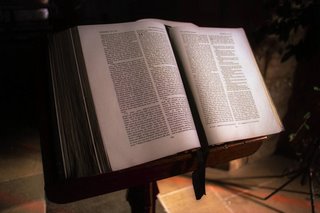 while "in the mix" since the 16th century, wasn't formalized until the early 20th century. In the light of the 19th century development of "modern" Biblical criticism, conservative Christians (who were soon dubbed "fundamentalists") declared a belief that the Bible is inerrant in order to combat the affect that modern criticism was having on the notion of Biblical authority. By the 1970s, many evangelicals had established the idea that inerrancy was one of the real tests of evangelicalism.
The problem is that historically speaking inerrancy has been foreign to Wesleyan theology (as demonstrated by Wesleyan theologians Dennis Bratcher, J. Kenneth Grider, and Gregory Neal, among others). The reason for this is that Methodists, from Wesley's day until today, have been primarly concerned with the soteriological message of Scripture; what does the Bible say about the salvation message?
The fifth of the Methodist Articles of Religion, entitled "Of the Sufficiency of the Holy Scriptures for Salvation", states in part:
Inerrancy has, at times, actually led to idolatry and sin. A common side effect of inerrancy has been termed "bibliolatry". The Bible is inspired and authoritative, but it is also a book written through the agency of human beings. Many who affirm inerrancy are aghast at the notion that the Bible is a very human book.
Christian orthodoxy has affirmed for centuries that Jesus was/is both fully divine and fully human; in fact, this affirmation is a legitimate test of orthodoxy. He wasn't "more God" or "more human"...he was fully both.
Why, then, do so many of our sisters and brothers who affirm inerrancy reject the idea that the Bible can also be a fully divine book as well as fully human? Frankly, to reject the human side of the Bible is to place the Bible above Jesus, which is clearly sinful. Jesus is the Lord of Scripture, and is himself above even the Holy Bible.
I have found it useful in my personal understanding to differentiate between Jesus as the one true Word of God (with a capital W) and the Bible as the living, active, supernatural word of God (with a lowercase w). Both are from God, but one is certainly superior to the other.
What, then, are we to say as Wesleyans about inerrancy?
First, we can strongly affirm Scriptural authority. The Bible is inspired by God and is essential, and is authoritative for the Church. It does indeed contain all that is necessary for salvation and, as such, we need to cling to the message of Scripture and live in its gracious words, allowing the Spirit to shape us and remake us using the Bible. (Anglican Bishop N.T. Wright, probably the top New Testament scholar on the planet today as well as one of the top evangelical theologians perhaps ever, has some good words to say about Biblical authority, while rejecting inerrancy.)
Second, we can be gracious to our sisters and brothers (generally of Calvinist persuasions) with whom we disagree regarding how best to define the ideas of Biblical inspiration and authority. We need not disparage those who do affirm inerrancy, even as we live in another room of God's house.
Third, we must see to it that modern Biblical criticism is responsibly applied. We have much to learn from Biblical critics, but too often their work is used to demean or belittle the Christian faith or important doctrines of the faith. Wesleyans have a responsibility as "Bible moths" to defend the Scriptures and see to it that criticism is applied properly. John Wesley once wrote, "The Church is to be judged by Scripture, not Scripture by the Church."
Fourth, we need to be "on guard" regarding the idolatry of bibliolatry. Most folks who commit this error do so unawares. While we must guard orthodoxy, we must do so in a loving way, graciously correcting and instructing our Christian brethren.
Finally, we need to focus on our mission, which is also the Bible's purpose. Our mission is to make disciples of Jesus Christ, and the Bible exists not that we might prove scientific details or historic happenings which don't even matter (in terms of the big picture), but that people might believe. As I said to a Presbyterian colleague in my seminary years, "We United Methodists are content to let you all and the Baptists worry about inerrancy; we're too busy saving souls." That was my smart-mouthed way of putting the debate into perspective; we should not be distracted by these interesting but ultimately silly debates when the task at hand is of such great import.
O Father of all the nations of the earth: Remember the multitudes who have been created in your image but have not known the redeeming work of our Savior Jesus Christ; and grant that, by the prayers and labors of your holy Church, they may be brought to know and worship you as you have been revealed in the Bible, your word, and preeminently in your Son, the Word; who lives and reigns with you and the Holy Spirit, one God, for ever and ever. Amen.
____________________________
Donald Haynes of Hood Theological Seminary has written a column for The United Methodist Reporter in which he deals with the question, "Is the Bible literally the Word of God?" In the article, Haynes strongly affirms Biblical authority while essentially rejecting the notion of "inerrancy".
The belief that the Bible is "inerrant" is a Calvinist doctrine which,
 while "in the mix" since the 16th century, wasn't formalized until the early 20th century. In the light of the 19th century development of "modern" Biblical criticism, conservative Christians (who were soon dubbed "fundamentalists") declared a belief that the Bible is inerrant in order to combat the affect that modern criticism was having on the notion of Biblical authority. By the 1970s, many evangelicals had established the idea that inerrancy was one of the real tests of evangelicalism.
The problem is that historically speaking inerrancy has been foreign to Wesleyan theology (as demonstrated by Wesleyan theologians Dennis Bratcher, J. Kenneth Grider, and Gregory Neal, among others). The reason for this is that Methodists, from Wesley's day until today, have been primarly concerned with the soteriological message of Scripture; what does the Bible say about the salvation message?
The fifth of the Methodist Articles of Religion, entitled "Of the Sufficiency of the Holy Scriptures for Salvation", states in part:
The Holy Scripture containeth all things necessary to salvation; so that whatsoever is not read therein, nor may be proved thereby, is not to be required of any man that it should be believed as an article of faith, or be thought requisite or necessary to salvation...The fourth article of the Evangelical United Brethren Confession of Faith similarly states, in part:
We believe the Holy Bible, Old and New Testaments, reveals the Word of God so far as it is necessary for our salvation. It is to be received through the Holy Spirit as the true rule and guide for faith and practice. Whatever is not revealed in or established by the Holy Scriptures is not to be made an article of faith nor is it to be taught as essential to salvation.Obviously, no mention is made of the notion of inerrancy, which is predated by the Methodist Articles.
Inerrancy has, at times, actually led to idolatry and sin. A common side effect of inerrancy has been termed "bibliolatry". The Bible is inspired and authoritative, but it is also a book written through the agency of human beings. Many who affirm inerrancy are aghast at the notion that the Bible is a very human book.
Christian orthodoxy has affirmed for centuries that Jesus was/is both fully divine and fully human; in fact, this affirmation is a legitimate test of orthodoxy. He wasn't "more God" or "more human"...he was fully both.
Why, then, do so many of our sisters and brothers who affirm
 inerrancy reject the idea that the Bible can also be a fully divine book as well as fully human? Frankly, to reject the human side of the Bible is to place the Bible above Jesus, which is clearly sinful. Jesus is the Lord of Scripture, and is himself above even the Holy Bible.
I have found it useful in my personal understanding to differentiate between Jesus as the one true Word of God (with a capital W) and the Bible as the living, active, supernatural word of God (with a lowercase w). Both are from God, but one is certainly superior to the other.
What, then, are we to say as Wesleyans about inerrancy?
First, we can strongly affirm Scriptural authority. The Bible is inspired by God and is essential, and is authoritative for the Church. It does indeed contain all that is necessary for salvation and, as such, we need to cling to the message of Scripture and live in its gracious words, allowing the Spirit to shape us and remake us using the Bible. (Anglican Bishop N.T. Wright, probably the top New Testament scholar on the planet today as well as one of the top evangelical theologians perhaps ever, has some good words to say about Biblical authority, while rejecting inerrancy.)
Second, we can be gracious to our sisters and brothers (generally of Calvinist persuasions) with whom we disagree regarding how best to define the ideas of Biblical inspiration and authority. We need not disparage those who do affirm inerrancy, even as we live in another room of God's house.
Third, we must see to it that modern Biblical criticism is responsibly applied. We have much to learn from Biblical critics, but too often their work is used to demean or belittle the Christian faith or important doctrines of the faith. Wesleyans have a responsibility as "Bible moths" to defend the Scriptures and see to it that criticism is applied properly. John Wesley once wrote, "The Church is to be judged by Scripture, not Scripture by the Church."
Fourth, we need to be "on guard" regarding the idolatry of bibliolatry. Most folks who commit this error do so unawares. While we must guard orthodoxy, we must do so in a loving way, graciously correcting and instructing our Christian brethren.
Finally, we need to focus on our mission, which is also the Bible's purpose. Our mission is to make disciples of Jesus Christ, and the Bible exists not that we might prove scientific details or historic happenings which don't even matter (in terms of the big picture), but that people might believe. As I said to a Presbyterian colleague in my seminary years, "We United Methodists are content to let you all and the Baptists worry about inerrancy; we're too busy saving souls." That was my smart-mouthed way of putting the debate into perspective; we should not be distracted by these interesting but ultimately silly debates when the task at hand is of such great import.
O Father of all the nations of the earth: Remember the multitudes who have been created in your image but have not known the redeeming work of our Savior Jesus Christ; and grant that, by the prayers and labors of your holy Church, they may be brought to know and worship you as you have been revealed in the Bible, your word, and preeminently in your Son, the Word; who lives and reigns with you and the Holy Spirit, one God, for ever and ever. Amen.
Tuesday, February 24, 2009
An Oscar Reflection: Has the Church failed Dustin Lance Black & Sean Penn?
"...to all of the gay and lesbian kids out there tonight who have been told that they are less than by their churches, by the government or by their families...you are beautiful, wonderful creatures of value and that no matter what anyone tells you, God does love you and that very soon, I promise you, you will have equal rights federally, across this great nation of ours."
"Thank you. You commie, homo-loving sons-of-guns...I think that it is a good time for those who voted for the ban against gay marriage to sit and reflect and anticipate their great shame and the shame in their grandchildren's eyes if they continue that way of support. We've got to have equal rights for everyone."
I have no doubt that radical voices at the fringes of the Church have expressed outright hatred for anyone who struggles with or practices homosexual behavior; the Fred Phelps cult - which cannot really be termed a part of the Christian Church - has done some horrid, despicable, demonic things.
But the Church has done its best and continues to do its best to express God's love for all people. It is certainly true that:
Mr. Black and actor Sean Penn seem to believe something about the Church that is not true, and perhaps the Church is in part to blame. Mr. Black is correct: gays and lesbians are "...beautiful, wonderful creatures of value and that no matter what anyone tells you, God does love you." That is a statement with which every thinking, compassionate Christian can agree. What churches have taught him something else? I wish he'd "named names"!
Have we failed to share with Mr. Black the amazing cosmic truth that God loves him, that Jesus died and rose for him, that the Creator of the universe desires to be in a salvific, transformative relationship with him? Shame on us for not reaching this gifted young man with the heart of the gospel, that he now believes something about the Church that is inherently false.
Then again, my understanding is that Mr. Black was raised in a Mormon environment, and, while I haven't seen anything hateful about mainstream contemporary Mormonism, I'm no expert on their theology or practice, other than to say that I don't believe it to be Biblically or doctrinally Christian. So it's possible that Mr. Black is reflecting on some Mormon practice of which I am ignorant.
But both Mr. Black and Mr. Penn mischaracterized the "gay marriage" debate at the Oscars on Monday night. I know a lot of Christians, and I don't know of one who does not favor equal rights. The fact that Christians have opposed California's "Prop 8" and similar measures in other states isn't because Christians want to deny everyone "equal rights", nor is it out of hate.
Christians oppose "gay marriage" because they love gay persons. If indeed homosexual practice is "incompatible with Christian teaching", then the Christians are compelled to help those individuals engaged in sinful behaviors to be liberated from those behaviors. This is equally true for those engaged in sinful heterosexual practices, or sinful practices which have nothing to do with sex. Sanctioning behavior believed to be sin would be extremely hateful, and, thankfully, the Church has thus far refused to do so.
To mischaracterize those opposed to sanctioning homosexual practice as hateful is not only a lie, it is mean. And possibly hateful. Or at the very least ignorant.
My prayer is twofold: that we can raise the discourse of the debate so as not to characterize our opponents as hateful, when no one involved in the debate is actually driven by hatred, and that the Church can find ways to be more effective in sharing the life-changing gospel - which is "good news", after all - so that all persons can know and praise God's wonderful work in Jesus Christ, submit to his Lordship (and his alone), and be emancipated from the great bondage of sin - sexual and otherwise.
Almighty and everlasting God, whose will it is to restore all things in your well-beloved Son, the King of kings and Lord of lords: Mercifully grant that the peoples of the earth, divided and enslaved by sin, may be freed and brought together under his most gracious rule; who lives and reigns with you and the Holy Spirit, one God, now and forever. Amen. (BCP)
(Note in the interest of full disclosure: I have not yet seen the film Milk, but have no doubt that the always brilliant Sean Penn delivered an excellent performance.)
- from Dustin Lance Black's speech after winning the Academy Award
for Best Original Screenplay for Milk
for Best Original Screenplay for Milk
"Thank
 you. You commie, homo-loving sons-of-guns...I think that it is a good time for those who voted for the ban against gay marriage to sit and reflect and anticipate their great shame and the shame in their grandchildren's eyes if they continue that way of support. We've got to have equal rights for everyone."
- from Sean Penn's speech after winning the Academy Award for Best Actor for his performance in Milk
I have no doubt that radical voices at the fringes of the Church have expressed outright hatred for anyone who struggles with or practices homosexual behavior; the Fred Phelps cult - which cannot really be termed a part of the Christian Church - has done some horrid, despicable, demonic things.
But the Church has done its best and continues to do its best to express God's love for all people. It is certainly true that:
"The United Methodist Church does not condone the practice of homosexuality and considers this practice incompatible with Christian teaching."This famous quote from paragraph 161G of the Social Principles in our Book of Discipline should not be read or interpreted in a vacuum, or taken out of context:
"Homosexual persons no less than heterosexual persons are individuals of sacred worth. All persons need the ministry and guidance of the church in their struggles for human fulfillment, as well as the spiritual and emotional care of a fellowship that enables reconciling relationships with God, with others, and with self. The United Methodist Church does not condone the practice of homosexuality and considers this practice incompatible with Christian teaching. We affirm that God's grace is available to all, and we will seek to live together in Christian community. We implore families and churches not to reject or condemn lesbian and gay members and friends. We commit ourselves to be in ministry for and with all persons."If a local congregation has told writer Dustin Lance Black that he is "less than" because of his sex decisions, then shame on that local congregation. Every person - straight or gay - is sacred in God's eyes, and Jesus died for each. God loves Dustin Lance Black just as he loves Keith McIlwain or Billy Graham or Pope Benedict XVI or Ellen Degeneres or even Fred Phelps. God may be disappointed by some of the decisions we make (I'm sure that I am a constant disappointment), but that divine love does not cease.
Mr. Black
 and actor Sean Penn seem to believe something about the Church that is not true, and perhaps the Church is in part to blame. Mr. Black is correct: gays and lesbians are "...beautiful, wonderful creatures of value and that no matter what anyone tells you, God does love you." That is a statement with which every thinking, compassionate Christian can agree. What churches have taught him something else? I wish he'd "named names"!
Have we failed to share with Mr. Black the amazing cosmic truth that God loves him, that Jesus died and rose for him, that the Creator of the universe desires to be in a salvific, transformative relationship with him? Shame on us for not reaching this gifted young man with the heart of the gospel, that he now believes something about the Church that is inherently false.
Then again, my understanding is that Mr. Black was raised in a Mormon environment, and, while I haven't seen anything hateful about mainstream contemporary Mormonism, I'm no expert on their theology or practice, other than to say that I don't believe it to be Biblically or doctrinally Christian. So it's possible that Mr. Black is reflecting on some Mormon practice of which I am ignorant.
But both Mr. Black and Mr. Penn mischaracterized the "gay marriage" debate at the Oscars on Monday night. I know a lot of Christians, and I don't know of one who does not favor equal rights. The fact that Christians have opposed California's "Prop 8" and similar measures in other states isn't because Christians want to deny everyone "equal rights", nor is it out of hate.
Christians oppose "gay marriage" because they love gay persons. If indeed homosexual practice is "incompatible with Christian teaching", then the Christians are compelled to help those individuals engaged in sinful behaviors to be liberated from those behaviors. This is equally true for those engaged in sinful heterosexual practices, or sinful practices which have nothing to do with sex. Sanctioning behavior believed to be sin would be extremely hateful, and, thankfully, the Church has thus far refused to do so.
To mischaracterize those opposed to sanctioning homosexual practice as hateful is not only a lie, it is mean. And possibly hateful. Or at the very least ignorant.
My prayer is twofold: that we can raise the discourse of the debate so as not to characterize our opponents as hateful, when no one involved in the debate is actually driven by hatred, and that the Church can find ways to be more effective in sharing the life-changing gospel - which is "good news", after all - so that all persons can know and praise God's wonderful work in Jesus Christ, submit to his Lordship (and his alone), and be emancipated from the great bondage of sin - sexual and otherwise.
Almighty and everlasting God, whose will it is to restore all things in your well-beloved Son, the King of kings and Lord of lords: Mercifully grant that the peoples of the earth, divided and enslaved by sin, may be freed and brought together under his most gracious rule; who lives and reigns with you and the Holy Spirit, one God, now and forever. Amen. (BCP)
(Note in the interest of full disclosure: I have not yet seen the film Milk, but have no doubt that the always brilliant Sean Penn delivered an excellent performance.)
Friday, February 20, 2009
Brian Wren
Brian Wren, writer of fourteen items in The United Methodist Hymnal (1989), has suffered a stroke and is hospitalized in a Boston hospital. Among his contributions which I use often are #111 "How Can We Name a Love", #260 "Christ, upon the Mountain Peak", #307 "Christ Is Risen", #318 "Christ Is Alive", and #383 "This is a Day of New Beginnings".
Wren's wife Susan is a United Methodist pastor serving the Martha’s Vineyard Cooperative Parish in Massachusetts. The latest news is that he had surgery yesterday.
The General Board of Discipleship has initiated a blog for folks to track Wren's progress; you can check that out here.
Heavenly Father, giver of life and health: Comfort and relieve your ailing servant Brian Wren, and give your power of healing to those who minister to his needs, that he may be strengthened in his weakness and have confidence in your loving care; through Jesus Christ our Lord, who lives and reigns with you and the Holy Spirit, one God, now and forever. Amen. (BCP, adapt.)
Monday, February 16, 2009
Rerun: I See Dead People
"Six days later, Jesus took with him Peter and James and John, and led them up a high mountain apart, by themselves. And he was transfigured before them, and his clothes became dazzling white, such as no one on earth could bleach them. And there appeared to them Elijah with Moses, who were talking with Jesus.
"Then Peter said to Jesus, 'Rabbi, it is good for us to be here; let us make three dwellings, one for you, one for Moses, and one for Elijah.' He did not know what to say, for they were terrified.
"Then a cloud overshadowed them, and from the cloud there came a voice, 'This is my Son, the Beloved; listen to him!' Suddenly when they looked around, they saw no one with them any more, but only Jesus.
"As they were coming down the mountain, he ordered them to tell no one about what they had seen, until after the Son of Man had risen from the dead."
Why is it that preachers often preach this story from the perspective of the wonders of a "mountaintop high"? Too often, we fall into the mindset that the Transfiguration story is one that points to the idea that while these "highs" can be wonderful, we need to return to the valleys, where the people live and where there is ministry to be done.
We tend to obscure this simple fact: this story is scary! Jesus glows and then is joined by two dead prophets! What we have here is a ghost story!
In this light, we are reminded that Transfiguration Sunday happens each year just before Lent, and that the real theme of this story is not the wonderful high of a mountaintop experience, but the cold, frightening anticipation of death. After this event, Jesus began to turn his face toward Jerusalem and "the fate that awaited him" there.
We have here an excellent "pre-Lent" narrative, a fine opportunity to begin the preparations for the dark pain of Good Friday as well as the unspeakable joy of Easter. Let's not just "get through" Transfiguration Sunday without giving this remarkably opportunity its due, and without giving this creepy text the macabre attention it deserves.
 days later, Jesus took with him Peter and James and John, and led them up a high mountain apart, by themselves. And he was transfigured before them, and his clothes became dazzling white, such as no one on earth could bleach them. And there appeared to them Elijah with Moses, who were talking with Jesus.
"Then Peter said to Jesus, 'Rabbi, it is good for us to be here; let us make three dwellings, one for you, one for Moses, and one for Elijah.' He did not know what to say, for they were terrified.
"Then a cloud overshadowed them, and from the cloud there came a voice, 'This is my Son, the Beloved; listen to him!' Suddenly when they looked around, they saw no one with them any more, but only Jesus.
"As they were coming down the mountain, he ordered them to tell no one about what they had seen, until after the Son of Man had risen from the dead."
- Mark 9:2-9 (NRSV)
Why is it that preachers often preach this story from the perspective of the wonders of a "mountaintop high"? Too often, we fall into the mindset that the Transfiguration story is one that points to the idea that while these "highs" can be wonderful, we need to return to the valleys, where the people live and where there is ministry to be done.
We tend to obscure this simple fact: this story is scary! Jesus glows and then is joined by two dead prophets! What we have here is a ghost story!
In this light, we are reminded that Transfiguration Sunday happens each year just before Lent, and that the real theme of this story is not the wonderful high of a mountaintop experience, but the cold, frightening anticipation of death. After this event, Jesus began to turn his face toward Jerusalem and "the fate that awaited him" there.
We have here an excellent "pre-Lent" narrative, a fine opportunity to begin the preparations for the dark pain of Good Friday as well as the unspeakable joy of Easter. Let's not just "get through" Transfiguration Sunday without giving this remarkably opportunity its due, and without giving this creepy text the macabre attention it deserves.
Originally posted 2/13/2007
Presidents Day list: Best U.S. Presidents
(According to me!)
1 - Abraham Lincoln
2 - George Washington
3 - Theodore Roosevelt
4 - Ronald Reagan
5 - Franklin Roosevelt
6 - James Polk
7 - Andrew Jackson
8 - Thomas Jefferson
9 - John Adams
10 - Grover Cleveland
1 -
 Abraham Lincoln
2 - George Washington
3 - Theodore Roosevelt
4 - Ronald Reagan
5 - Franklin Roosevelt
6 - James Polk
7 - Andrew Jackson
8 - Thomas Jefferson
9 - John Adams
10 - Grover Cleveland
Monday, February 09, 2009
Friday, February 06, 2009
Good Reminder for the Day
"Only a renewed pastor can revive a sleeping congregation."
- Andrew Purves
Tuesday, February 03, 2009
Postmodern Love?
Postmodernism has been a key part of conversation in the Church in the past few years. For many of us, it has taken shape in the "emerging church" movement (or "conversation"). While much of the "emerging conversation" appeals to me, I have concerns as well. I detailed some aspects of "emerging Christianity" in this post from March 2007.
Some aspects of emerging postmodern Christianity with which I agree are:
* the embrace of current technology as a means to live and communicate;
* the reduction of dogmatics to an essential core;
* an awareness of popular culture and the rejection of what has become a very bizarre evangelical Christian subculture, with its own books, music, and discourse;
* an emphasis on covenant community and, thus, on the sacramental life.
I have concerns about postmodern Christianity as well, such as:
* a rejection of symbol and meaningful tradition;
* a rejection of metanarrative;
* a tendency to ignore some essential doctrines which may or may not be viewed as "current";
* a desire to be current.
In Western PA Conference, we have several congregations which are attenpting to develop postmodern communities which may or may not actually be postmodern, which is fine. The only community of faith I know of in our area which is certainly postmodern in Hot Metal Bridge. But even this community of faith is on the "right wing" of the emergeing movement, as the pastors are theologically solidly evangelical (though again, they've rejected, in many ways, the evangelical subculture). My own opinion is that an established congregation, steeped in modernity, cannot birth a postmodern community, definitionally; it would be like a tiger giving birth to a shark.
Should we seek to begin more distinctly postmodern communities of faith?
I have two primary concerns about postmodern Christianity.
First, our desire to "hip", "relevant", "current", "sexy" and "now" can hurt more than help. I look at the recent trials of Radiant Life, a community of faith birthed in a mall. It seems to me that we as a Conference saw something "cool" and jumped at it, without proper theological reflection or planning appropriately. As a result, the congregation failed and the family which was appointed to work the launch has been hurt; not the Church at its best.
I write these words as a self-avowed geek who is keenly aware that I am the least hip person on the planet (a fact to which my teenage children can speak to ad nauseum). The gospel is already perfect and relevant. We don't need to hip it up. While looking for different ways to spread the gospel is good, we need better exegesis far more than we need better locations. Biblical reflection will acccomplish much more than strategic planning. Doctrinal obedience and faithful living are far greater tools than the latest fads; confession of sins and the Eucharist are far more effective than the latest technology.
I don't need to make the gospel more relevant; Jesus already made it completely relevant on Good Friday and Easter Sunday. I need to be more faithful in my living out of his gospel and in my sharing of this transformational news. Method can never trump message.
Our desire to be hip and current should not override other valid issues, and far too often, I fear that it does.
Some aspects of emerging postmodern Christianity with which I agree
 are:
* the embrace of current technology as a means to live and communicate;
* the reduction of dogmatics to an essential core;
* an awareness of popular culture and the rejection of what has become a very bizarre evangelical Christian subculture, with its own books, music, and discourse;
* an emphasis on covenant community and, thus, on the sacramental life.
I have concerns about postmodern Christianity as well, such as:
* a rejection of symbol and meaningful tradition;
* a rejection of metanarrative;
* a tendency to ignore some essential doctrines which may or may not be viewed as "current";
* a desire to be current.
In Western PA Conference, we have several congregations which are attenpting to develop postmodern communities which may or may not actually be postmodern, which is fine. The only community of faith I know of in our area which is certainly postmodern in Hot Metal Bridge.
 But even this community of faith is on the "right wing" of the emergeing movement, as the pastors are theologically solidly evangelical (though again, they've rejected, in many ways, the evangelical subculture). My own opinion is that an established congregation, steeped in modernity, cannot birth a postmodern community, definitionally; it would be like a tiger giving birth to a shark.
Should we seek to begin more distinctly postmodern communities of faith?
I have two primary concerns about postmodern Christianity.
First, our desire to "hip", "relevant", "current", "sexy" and "now" can hurt more than help. I look at the recent trials of Radiant Life, a community of faith birthed in a mall. It seems to me that we as a Conference saw something "cool" and jumped at it, without proper theological reflection or planning appropriately. As a result, the congregation failed and the family which was appointed to work the launch has been hurt; not the Church at its best.
I write these words as a self-avowed geek who is keenly aware that I am the least hip person on the planet (a fact to which my teenage children can speak to ad nauseum). The gospel is already perfect and relevant. We don't need to hip it up. While looking for different ways to spread the gospel is good, we need better exegesis far more than we need better locations. Biblical reflection will acccomplish much more than strategic planning. Doctrinal obedience and faithful living are far greater tools than the latest fads; confession of sins and the Eucharist are far more effective than the latest technology.
I don't need to make the gospel more relevant; Jesus already made it completely relevant on Good Friday and Easter Sunday. I need to be more faithful in my living out of his gospel and in my sharing of this transformational news. Method can never trump message.
Our desire to be hip and current should not override other valid issues, and far too often, I fear that it does.
Second, those of us who call ourselves evangelical need to remember the failures of modernism."The church is looking for better methods;
God is looking for better men." - E. M. Bounds
Evangelicalism is, for me, "the old, old story", shared by the apostles and the Church fathers, Luther, Calvin, Wesley, Asbury, and many others. It is not synonomous with fundamentalism or Methodism or Presbyterianism or Pentecostalism or Roman Catholicism or Eastern Orthodoxy, but it can include the best parts of each of these "subgroups". It is, for me, the faithful transmission of Jesus' gospel.
Modernism is something else. For me, it is synonomous with the theology of Friedrich  Schleiermacher and his theological descendents. It dominated the Church in the late 19th century and most of the 20th century, and still holds sway over denominational leadership. It was driven by a desire to be hip, current, and relevant, and is now tired and old. Much of the most vital current Christianity is a reaction against modernism.
 Schleiermacher and his theological descendents. It dominated the Church in the late 19th century and most of the 20th century, and still holds sway over denominational leadership. It was driven by a desire to be hip, current, and relevant, and is now tired and old. Much of the most vital current Christianity is a reaction against modernism.
Modernism has not produced any great denominations, nor has it resulted in astounding missional success. Those who have embraced modernism have presided over the decline of the western Church, but were blind to their failings because of their
desire to be relevant.
We should be very careful about tying our boats to the uncertain ship that is postmodernism. It suffers from many of the same weaknesses of its parent, and has an uncertain future.
Let's go back to our roots instead...the Bible, the Church fathers and, for United Methodists, the Articles of Religion, the sermons and explanatory notes of John Wesley, even the hymns of Charles Wesley. Surely, these are far better guides than the latest philosophical fad.
And if we are able to stop caring about our own relevance and hipness, maybe we'll realize just how current and relevant Jesus already is...and has always been.
Friday, January 30, 2009
Words Matter
Last Sunday, Speaker of the House Nancy Pelosi (D-CA) appeared on ABC's This Week with George Stephanopoulos. Speaking about the pending "economic stimulus" package championed by President Obama, Speaker Pelosi, and most other Democrat leaders, an exchange occurred which has since been spread all over the blogosphere...
 am not the only person in America who has found the Speaker's words very disturbing. I am pleased that, with the support of the President, these provisions have been removed from the package.
The initial television exchange, however, remains very disturbing to me because it shows a radical difference in worldview from my own.
Speaker Pelosi is a strong, vocal supporter of legal abortion, sometimes misunderstanding the teachings of her denomination (the Roman Catholic Church). It would not be surprising to see her vote for any measure which would support legal abortion or speak in support of such a measure.
What dismays me is that in the exchange with George Stephanopoulos, Speaker Pelosi seems to reduce "family planning" to economics. We need to support such measures, she claimed, because they will "reduce costs" to the government, and that these are simply "the consequences of the downturn in our economy." There is no mention of human rights or what might be best for the baby, the parents, or the family. "Family planning" has been reduced to dollars and cents. One might ask, "What is a baby worth?"
To be fair, Speaker Pelosi and the Democrats may not have been including abortion in the "family planning" section of the "stimulus" package; I have not read the proposed bills. She may only have been referring to condoms and birth control pills.
Even so, the Speaker's words tread on dangerous ground. I'm not ready to join those who have accused the Speaker of supporting eugenics, though her words may come close to doing so. I'm more willing to believe that she simply chose her words poorly...very poorly. But when we begin to think of babies and children in terms of economics and not in terms of their inherent worth as precious human souls for whom Jesus died, we take another step further on the road to dehumanization, and that can make eugenics and other atrocities possible.
ISTEPHANOPOULOS: Hundreds of millions of dollars to expand family planning services. How is that stimulus?
PELOSI: Well, the family planning services reduce cost. They reduce cost. The states are in terrible fiscal budget crises now and part of what we do for children's health, education and some of those elements are to help the states meet their financial needs. One of those - one of the initiatives you mentioned, the contraception, will reduce costs to the states and to the federal government.STEPHANOPOULOS: So no apologies for that?
PELOSI: No apologies. No. We have to deal with the consequences of the downturn in our economy.
 am not the only person in America who has found the Speaker's words very disturbing. I am pleased that, with the support of the President, these provisions have been removed from the package.
The initial television exchange, however, remains very disturbing to me because it shows a radical difference in worldview from my own.
Speaker Pelosi is a strong, vocal supporter of legal abortion, sometimes misunderstanding the teachings of her denomination (the Roman Catholic Church). It would not be surprising to see her vote for any measure which would support legal abortion or speak in support of such a measure.
What dismays me is that in the exchange with George Stephanopoulos, Speaker Pelosi seems to reduce "family planning" to economics. We need to support such measures, she claimed, because they will "reduce costs" to the government, and that these are simply "the consequences of the downturn in our economy." There is no mention of human rights or what might be best for the baby, the parents, or the family. "Family planning" has been reduced to dollars and cents. One might ask, "What is a baby worth?"
To be fair, Speaker Pelosi and the Democrats may not have been including abortion in the "family planning" section of the "stimulus" package; I have not read the proposed bills. She may only have been referring to condoms and birth control pills.
Even so, the Speaker's words tread on dangerous ground. I'm not ready to join those who have accused the Speaker of supporting eugenics, though her words may come close to doing so. I'm more willing to believe that she simply chose her words poorly...very poorly. But when we begin to think of babies and children in terms of economics and not in terms of their inherent worth as precious human souls for whom Jesus died, we take another step further on the road to dehumanization, and that can make eugenics and other atrocities possible.
Subscribe to:
Posts (Atom)