 The article, found here, was written by Matt Friedman, a professor at Wesley Biblical Seminary in Jackson, Mississippi.
In his article, Professor Friedman analyzes a report by "Church Growth Today" (found here) which names the Top 50 Most Influential Churches in America. An interesting list, Friedman correctly points to some flaws and qualifiers regarding the list.
First, the report only consulted non-Roman Catholic clergy and only included non-Roman Catholic churches on its list. Is it that unreasonable to expect at least one congregation of the largest denomination in the country might make the list? What is "Church Growth Today" afraid of? Yes, Roman Catholic ministry tends to be very different from much Protestant ministry, but that doesn't invalidate an entire denomination.
Second, the report only consulted the pastors of the nation's largest (non-Roman Catholic) congregations. In other words, the report tells us how large church pastors influence one another, but may not say much about how influential these churches are among the majority of Christians in America, who do not worship in these "megachurches".
Finally, Professor Friedman properly asks if this poll is a fair and accurate measure of actual ministry. A rural congregation of 50 might be doing miraculous ministry in its context, and may be producing far more tasty fruit than a large megachurch; this little church may ultimately have far more influence than a megachurch.
Why does it seem that so many Christians in America are obsessed with size?
 Why do so many of us play the numbers game? Why are we at times seemingly unable to focus on people?
Now, that said, many of the churches which made the list are doing wonderful things. There's no denying the influence of Willow Creek and Saddleback. Southeast, Resurrection, Mars Hill, Frazer, and Windsor Village are all doing tremendous things. Some of the churches on the list have serious theological problems. Some present a very watered-down Gospel.
The point is that a tree which produces a great deal of fruit is not necessarily a tree which produces the best quality fruit or the tastiest fruit. Let us not get too preoccupied with contemporary numerology, which emphasizes numbers, at the expense of faithfully harvesting excellent fruit.


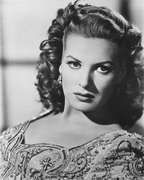

 excellent players don't always make it into the Hall. Players need that certain "something extra" to enjoy induction.
 I feel like we're officially moved now, though there are still a few boxes around. Robyn did a TREMENDOUS job packing and unpacking. Sure, the rest of us helped, but she did the bulk of it all. All that ability, and she's easy on the eyes...I'm blessed!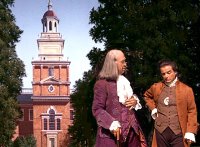

 From time to time on my blog, I may mention some who could be candidates. Today it's Oprah Winfrey. She is a very powerful, very wealthy talk-show host who "earned" her money like talk-show hosts generally do...by exploiting the pain of other people. So many folks just adore Oprah, clinging to her every word (and, yes, I know she gives to a lot of charities). She has a definite spiritual side, though it seems to me to be very syncretistic and vague, not specifically Christian. For more on her spirituality, see
  The article also features a picture of Jefferson United Methodist Church. You can read the online article
  The past two weeks we have been packing (well, Robyn's doing most of that) and recovering from my ankle injury. The three oldest kids are at camp all week. Sunday, it's my first sermon at Jefferson UMC. Thursday, July 6...our anniversary...is the day we move to the new parsonage. We ask for prayers!
 The Holiness movement is a revivalistic offshoot of Methodism, and is generally more focused on sanctification than most United Methodists. They claim (correctly) spiritual descent from John Wesley; many of the finest Wesleyan scholars and theologians in recent years have come not from United Methodism, but from Holiness denominations. Generally, they are part of the "conservative" wing of the Wesleyan movement, even as United Methodism is the "centrist" or "left" wing. Holiness groups include the Church of the Nazarene, the Free Methodist Church, and the Salvation Army.
 The manifesto begins by recognizing the decline of the American Church and that many have grasped at the latest trends as potential ways to not only stop the decline but to more faithfully execute our mission. The document calls us to clarity, hoping that we might recommit to mission as opposed to maintenance, survival, or trendiness.
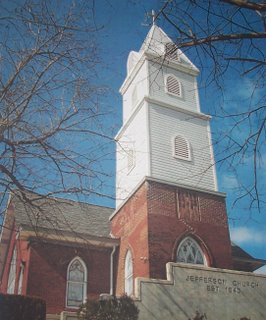 We are excited about the opportunities for ministry God is bringing our way in the beautiful Jefferson Hills area, a southern suburb of Pittsburgh. To the right is an exterior view of the church. The lovely steeple is a relatively new addition. The church sits on the third highest elevation in Allegheny County. A few years ago, the Sprint telephone company asked to place a phone tower on the church, building a steeple around the tower. So, the steeple was built at no cost to the congregation! That's the way to do it!
 To the left is a picture of the front of the church sanctuary. It has been completely remodeled in the last five years; it reminds me of a beautiful Episcopalian chapel. Relatively small, it seats only about 135 people, which means the church has had to move to two Sunday morning worship services and are looking to possibly add a Saturday evening service.
 The Bishop opened Conference this year by urging us to be less pessimistic, more joyful (you can read a news article about this
  a wonderful job all the way around by guest preacher Bishop Violet Fisher, and the passing of a very ambitious strategic plan, designed to "jump start" our ministry attempts here in western Pennsylvania. Of course, a personal highlight for me is always reconnecting with sisters and brothers in Christ, spending some time with them, catching up, and lovingly making fun of a few of them. One evening of Conference for me and a few friends was spent heading north to Edinboro, PA, where we had a great dinner at John's Wildwood Pizza and spent some time together away from the busy-ness of Annual Conference. There are times throughout the year when I cling to these "light" moments, when we can relax, exhale, and just be the family of God. We - certainly I - need more moments like this! This is what, for me, makes Conference a
  A few years ago, Rev. Sharon Schwab, a leader of our Conference, asked for volunteers to help plan this celebration. Shockingly, I was the only male who responded to her request...evidence that we still have a
  It was a fine Annual Conference...some headaches, sure...but overall very positive. Our Conference adopted a new strategic plan creating exciting opportunities, we were united in some quality worship, and, most importantly, Bishop Thomas Bickerton continued his joyful, forward-thinking leadership, inspiring and challenging us all. I'll give more details in the days ahead, as I am now quite tired. In the meantime, stories and pictures of Annual Conference 2006 can be enjoyed