- Kent Carlson
Showing posts with label emergent. Show all posts
Showing posts with label emergent. Show all posts
Thursday, October 07, 2010
Ambition & Success
"I am convinced that personal pastoral ambition, and a pastoral ethic centered around productivity and success is brutal to our souls and destructive to the souls of the people we lead. I believe there is a better way. But it requires us to walk right into the messiness of our own ambitious hearts, ready to die to those ambitions. We must become skilled at detecting the odor of personal ambition, then flee from it as if the church's future depends on it. For I believe it does."


Monday, September 13, 2010

Thursday, September 09, 2010

Monday, August 30, 2010
Monday, August 23, 2010
The Missional Conundrum
"Jesus told us to go into all the world and be his ambassadors, but many churches today have inadvertently changed the 'go and be' command to a 'come and see' appeal. We have grown attached to buildings, programs, staff and a wide variety of goods and services designed to attract and entertain people.
"Missional is a helpful term used to describe what happens when you and I replace the 'come to us' invitations with a 'go to them' life. A life where 'the way of Jesus' informs and radically transforms our existence to one wholly focused on sacrificially living for him and others and where we adopt a missionary stance in relation to our culture. It speaks of the very nature of the Jesus follower."
 told us to go into all the world and be his ambassadors, but many churches today have inadvertently changed the 'go and be' command to a 'come and see' appeal. We have grown attached to buildings, programs, staff and a wide variety of goods and services designed to attract and entertain people.
"Missional is a helpful term used to describe what happens when you and I replace the 'come to us' invitations with a 'go to them' life. A life where 'the way of Jesus' informs and radically transforms our existence to one wholly focused on sacrificially living for him and others and where we adopt a missionary stance in relation to our culture. It speaks of the very nature of the Jesus follower."
- Rick Meigs
Wednesday, August 11, 2010
5 Reasons Teens Are Avoiding Church
The daily newspaper USA Today recently published an article detailing why teens generally don't "go to church". While the article makes some good points, Shane Raynor disagrees with the article's take and offers five additional reasons why many teens have failed to make "church" a priority. In my opinion, Shane hits the nail on the head.
Shane's suggestions:
* Teens don’t show up because they don’t think God is showing up.
Our desperation to be "hip", "current", and "relevant" has often resulted in a shallowness that must be offensive to Jesus...shallow preaching, shallow music, shallow language, etc. The truth is that depth matters; relationships matter. Ministry is more than simply pizza and volleyball...
As in every aspect of life, we lead by example. It is crucial for parents to be involved in worship and ministry if they desire to see their children involved in worship and ministry....weekly...daily.
Additionally, parents must begin to say, "Sorry; worship of Almighty God is more important than soccer or basketball or sleeping in. You can't participate in that league if they require Sunday morning participation." Shane adds, "I’ve realized that there’s absolutely nothing wrong with making teenagers go to church."
That's Christian parenting. It's a shame if the kids have to miss out on sports or other activities, but what if...what if their souls are at stake? Is that a possibility? Parents ignore this piece of parenthood at their own peril, and at the possible expense of their children's spiritual walk. Priorities matter, and your children are watching...and learning.
* Teens are very connected to each other now and don’t need church to hook up anymore.
More could be said about this. We have largely forgotten in the church what real, authentic "community" is all about and why relationships founded on Jesus are far deeper than others. Shane makes the point that, "...there’s probably somewhere or something else that does community better than church." Penitence is needed on the part of the church. We need to be in prayer about this one.
* Unchurched teens see no significant difference between church kids and everyone else.
This was certainly true when I was a teen. The cruelest kids in my high school were often myself and other members of my church youth group. That isn't to say we didn't take Jesus seriously, but living that out is extraordinarily difficult.
As a parent and as a pastor, I see that teen members of the church I am serving are often just as drama-driven and hormone-driven as those who are "outside the church". It's heartbreaking but it's true. I certainly need to be more intentional about mentoring these fine young people, whom I truly love. We all need to do better and be more more faithful.
* Many teens get impatient with churches that major on the minors and try too hard to seem relevant.
Welcome to life in The United Methodist Church, where we have made this into an art form. We often teach our young people - either directly or indirectly - that aspects of the faith such as Jesus, his Lordship, Biblical study and reflection, and/or doctrine are secondary to ridding the world of malaria or to having an open heart, an open mind, and an open door.
Please don't misunderstand me. Fighting malaria is a noble cause, and if a pastor or congregation is passionate about it, then I am all for it. Likewise, it is appropriate to be available to discuss "out of the mainstream" ideas and approaches to life.
But these ministries should not be emphasized at the expense of other pieces of our journey in faith. Teens are not stupid. They can see when we are "majoring on the minors" and, if necessary, they'll find a community where all the means of grace are taken seriously, rather than just a few which have been carefully selected to be as least offensive as possible.
I commend to you Shane's original post, and urge prayerful reflection on this important subject.
 daily newspaper USA Today recently published an article detailing why teens generally don't "go to church". While the article makes some good points, Shane Raynor disagrees with the article's take and offers five additional reasons why many teens have failed to make "church" a priority. In my opinion, Shane hits the nail on the head.
Shane's suggestions:
* Teens don’t show up because they don’t think God is showing up.
Our desperation to be "hip", "current", and "relevant" has often resulted in a shallowness that must be offensive to Jesus...shallow preaching, shallow music, shallow language, etc. The truth is that depth matters; relationships matter. Ministry is more than simply pizza and volleyball...
"Sooner or later, everyone wants substance, and if it isn’t there, they’re going to bail. There’s always going to be a church (or someplace else) with better pizza, a more talented band, a better gym and bigger crowds with hotter people. It’s okay to use draws, but you’d better have a good foundation for your ministry and back up the draw with something real."* Teens don’t make church a priority because their parents don’t make it a priority.
As in every aspect of life, we lead by example. It is crucial for parents to be involved in worship and ministry if they desire to see their children involved in worship and ministry....weekly...daily.
Additionally,
 parents must begin to say, "Sorry; worship of Almighty God is more important than soccer or basketball or sleeping in. You can't participate in that league if they require Sunday morning participation." Shane adds, "I’ve realized that there’s absolutely nothing wrong with making teenagers go to church."
That's Christian parenting. It's a shame if the kids have to miss out on sports or other activities, but what if...what if their souls are at stake? Is that a possibility? Parents ignore this piece of parenthood at their own peril, and at the possible expense of their children's spiritual walk. Priorities matter, and your children are watching...and learning.
* Teens are very connected to each other now and don’t need church to hook up anymore.
More could be said about this. We have largely forgotten in the church what real, authentic "community" is all about and why relationships founded on Jesus are far deeper than others. Shane makes the point that, "...there’s probably somewhere or something else that does community better than church." Penitence is needed on the part of the church. We need to be in prayer about this one.
* Unchurched teens see no significant difference between church kids and everyone else.
This was certainly true when I was a teen. The cruelest kids in my high school
 were often myself and other members of my church youth group. That isn't to say we didn't take Jesus seriously, but living that out is extraordinarily difficult.
As a parent and as a pastor, I see that teen members of the church I am serving are often just as drama-driven and hormone-driven as those who are "outside the church". It's heartbreaking but it's true. I certainly need to be more intentional about mentoring these fine young people, whom I truly love. We all need to do better and be more more faithful.
* Many teens get impatient with churches that major on the minors and try too hard to seem relevant.
Welcome to life in The United Methodist Church, where we have made this into an art form. We often teach our young people - either directly or indirectly - that aspects of the faith such as Jesus, his Lordship, Biblical study and reflection, and/or doctrine are secondary to ridding the world of malaria or to having an open heart, an open mind, and an open door.
Please don't misunderstand me. Fighting malaria is a noble cause, and if a pastor or congregation is passionate about it, then I am all for it. Likewise, it is appropriate to be available to discuss "out of the mainstream" ideas and approaches to life.
But these ministries should not be emphasized at the expense of other pieces of our journey in faith. Teens are not stupid. They can see when we are "majoring on the minors" and, if necessary, they'll find a community where all the means of grace are taken seriously, rather than just a few which have been carefully selected to be as least offensive as possible.
I commend to you Shane's original post, and urge prayerful reflection on this important subject.
Monday, June 07, 2010
William Abraham on the Importance of Doctrine
"In the end, the church cannot endure without a body of systematic and coherent doctrine. This was not the problem Wesley faced two centuries ago. His challenge was to take the doctrine the church already possessed in her canonical traditions and make it accessible to the masses of his day.  Hence, he did not make doctrine a high priority in his efforts to renew the church of his day.
"Two hundred years later, the situation is radically reversed. We have become so doctrinally indifferent and illiterate that the church is starved of intellectual content. Indeed in many quarters the church has become internally secularized. It has no shared public discourse of its own, other than that borrowed from the secular world, to think through its pastoral care, its mission in the world, its evangelism, and its internal administration. Hence pastoral care is reduced to therapy, mission to sociopolitical action, evangelism to church growth, academic theology to amateur philosophical inquiry, and church administration to total quality management.
"To be sure, only a fool would claim that we cannot learn from the best secular inquiries of our day...Yet it is patently obvious that the Christian tradition has its own special way of thinking about its healing care, its mission, its evangelism, its internal structures, and the like. That special way of thinking is inescapably doctrinal...
"The recovery of doctrinal identity is not then some abstract exercise in constitutional archaeology; it is integral to the deep renewal of the life and work of the church in the current generation."
 Hence, he did not make doctrine a high priority in his efforts to renew the church of his day.
"Two hundred years later, the situation is radically reversed. We have become so doctrinally indifferent and illiterate that the church is starved of intellectual content. Indeed in many quarters the church has become internally secularized. It has no shared public discourse of its own, other than that borrowed from the secular world, to think through its pastoral care, its mission in the world, its evangelism, and its internal administration. Hence pastoral care is reduced to therapy, mission to sociopolitical action, evangelism to church growth, academic theology to amateur philosophical inquiry, and church administration to total quality management.
"To be sure, only a fool would claim that we cannot learn from the best secular inquiries of our day...Yet it is patently obvious that the Christian tradition has its own special way of thinking about its healing care, its mission, its evangelism, its internal structures, and the like. That special way of thinking is inescapably doctrinal...
"The recovery of doctrinal identity is not then some abstract exercise in constitutional archaeology; it is integral to the deep renewal of the life and work of the church in the current generation."
(William Abraham in Waking from Doctrinal Amnesia: The Healing
of Doctrine in the United Methodist Church, pp. 104-105)
thx to Jonathan Marlowe
of Doctrine in the United Methodist Church, pp. 104-105)
thx to Jonathan Marlowe
Thursday, June 03, 2010
Thomas Oden on Inclusivity & Christian Tradition
"That word ('inclusive') remains the key shibboleth of my hyper-liberated generation. We sought to be inclusive but managed to be so only within the strict limits of modern ideologies trapped in secular premises. In this captivity we systematically excluded most premodern wisdom.  Now I experience a gracious sense of multigenerational inclusion in the communion of saints. Those saints precede and transcend modern life and will survive its death. The faithful belong to a much more inclusive communion than is even conceivable within the limits of modern ideologies...
"Now I revel in the very premises I once carefully learned to set aside: the triune mystery, the preexistent Logos, the radical depth of sin passing through the generations, the risen Lord, the grace of baptism...
"Rather than interpreting the texts, I found the text interpreting me...
"It is the winter season for rigorous Christian teaching. Modernity is a winter season for classical Christianity. Spring will come, but only to those who have survived the winter."
 Now I experience a gracious sense of multigenerational inclusion in the communion of saints. Those saints precede and transcend modern life and will survive its death. The faithful belong to a much more inclusive communion than is even conceivable within the limits of modern ideologies...
"Now I revel in the very premises I once carefully learned to set aside: the triune mystery, the preexistent Logos, the radical depth of sin passing through the generations, the risen Lord, the grace of baptism...
"Rather than interpreting the texts, I found the text interpreting me...
"It is the winter season for rigorous Christian teaching. Modernity is a winter season for classical Christianity. Spring will come, but only to those who have survived the winter."
(quotes taken from various places in The Rebirth of Orthodoxy
and Agenda for Theology, both by Thomas C. Oden)
and Agenda for Theology, both by Thomas C. Oden)
thx to Jonathan Marlowe
Friday, May 14, 2010
The Missional Church...simple
This is a good brief summary of 21st century missional reality.
Most United Methodists & United Methodist congregations are (in my humble opinion) "trapped" in the model that begins around 0:07.
Annual Conference & denominational leadership tend to be (in my humble opinion) somewhere around 0:40.
Those models have both been effective, but both are dated (they're SO 20th century).
21st century "missional ministry", which actually refers back to an earlier time, begins around 1:15.
Definitely worth some prayerful reflection...
Most United Methodists & United Methodist congregations are (in my humble opinion) "trapped" in the model that begins around 0:07.
Annual Conference & denominational leadership tend to be (in my humble opinion) somewhere around 0:40.
Those models have both been effective, but both are dated (they're SO 20th century).
21st century "missional ministry", which actually refers back to an earlier time, begins around 1:15.
Definitely worth some prayerful reflection...
Sunday, March 28, 2010
A Lenten parable
"Let the same mind be in you that was in Christ Jesus,
who, though he was in the form of God,
did not regard equality with God as something to be exploited,
but emptied himself,
taking the form of a slave, being born in human likeness.
And being found in human form,
he humbled himself and became obedient to the point of death —
even death on a cross."
One Sunday in worship, a congregation received a rather large family as visitors.
After the service, the family spoke with the pastor, explaining that they had been members of another neighborhood congregation but were looking for a new church home that would serve their needs. They proceeded to begin asking the pastor various questions about the ministry and life of her congregation.
The pastor interrupted them by asking questions about their family and their activities, both in and out of church. “I’m not sure that our congregation is the place for you,“ the pastor told them, “for when it comes to joining our fellowship, we are far more interested in those who are willing to serve than those who are willing to be served.”
who, though he was in the form of God,
did not regard equality with God as something to be exploited,
but emptied himself,
taking the form of a slave, being born in human likeness.
And being found in human form,
he humbled himself and became obedient to the point of death —
even death on a cross."
- Philippians 2:5-8 (NRSV)
One
 Sunday in worship, a congregation received a rather large family as visitors.
After the service, the family spoke with the pastor, explaining that they had been members of another neighborhood congregation but were looking for a new church home that would serve their needs. They proceeded to begin asking the pastor various questions about the ministry and life of her congregation.
The pastor interrupted them by asking questions about their family and their activities, both in and out of church. “I’m not sure that our congregation is the place for you,“ the pastor told them, “for when it comes to joining our fellowship, we are far more interested in those who are willing to serve than those who are willing to be served.”
Sunday, August 09, 2009
Great post from Jay Voorhees
Over at Only Wonder Understands, the blog of Jay Voorhees (a UM pastor in Tennessee), we find a wonderful post entitled The Myth of Relevancy.
Jay mentions the seeming obsession in contemporary Church circles with the desire to be "relevant" and illustrates his concerns simply, briefly, and quite well. I recommend this post as some great food for thought.
 at Only Wonder Understands, the blog of Jay Voorhees (a UM pastor in Tennessee), we find a wonderful post entitled The Myth of Relevancy.
Jay mentions the seeming obsession in contemporary Church circles with the desire to be "relevant" and illustrates his concerns simply, briefly, and quite well. I recommend this post as some great food for thought.
Tuesday, February 03, 2009
Postmodern Love?
Postmodernism has been a key part of conversation in the Church in the past few years. For many of us, it has taken shape in the "emerging church" movement (or "conversation"). While much of the "emerging conversation" appeals to me, I have concerns as well. I detailed some aspects of "emerging Christianity" in this post from March 2007.
Some aspects of emerging postmodern Christianity with which I agree are:
are:
* the embrace of current technology as a means to live and communicate;
* the reduction of dogmatics to an essential core;
* an awareness of popular culture and the rejection of what has become a very bizarre evangelical Christian subculture, with its own books, music, and discourse;
* an emphasis on covenant community and, thus, on the sacramental life.
I have concerns about postmodern Christianity as well, such as:
* a rejection of symbol and meaningful tradition;
* a rejection of metanarrative;
* a tendency to ignore some essential doctrines which may or may not be viewed as "current";
* a desire to be current.
In Western PA Conference, we have several congregations which are attenpting to develop postmodern communities which may or may not actually be postmodern, which is fine. The only community of faith I know of in our area which is certainly postmodern in Hot Metal Bridge. But even this community of faith is on the "right wing" of the emergeing movement, as the pastors are theologically solidly evangelical (though again, they've rejected, in many ways, the evangelical subculture). My own opinion is that an established congregation, steeped in modernity, cannot birth a postmodern community, definitionally; it would be like a tiger giving birth to a shark.
Should we seek to begin more distinctly postmodern communities of faith?
I have two primary concerns about postmodern Christianity.
First, our desire to "hip", "relevant", "current", "sexy" and "now" can hurt more than help. I look at the recent trials of Radiant Life, a community of faith birthed in a mall. It seems to me that we as a Conference saw something "cool" and jumped at it, without proper theological reflection or planning appropriately. As a result, the congregation failed and the family which was appointed to work the launch has been hurt; not the Church at its best.
I write these words as a self-avowed geek who is keenly aware that I am the least hip person on the planet (a fact to which my teenage children can speak to ad nauseum). The gospel is already perfect and relevant. We don't need to hip it up. While looking for different ways to spread the gospel is good, we need better exegesis far more than we need better locations. Biblical reflection will acccomplish much more than strategic planning. Doctrinal obedience and faithful living are far greater tools than the latest fads; confession of sins and the Eucharist are far more effective than the latest technology.
I don't need to make the gospel more relevant; Jesus already made it completely relevant on Good Friday and Easter Sunday. I need to be more faithful in my living out of his gospel and in my sharing of this transformational news. Method can never trump message.
Our desire to be hip and current should not override other valid issues, and far too often, I fear that it does.
Some aspects of emerging postmodern Christianity with which I agree
 are:
are:* the embrace of current technology as a means to live and communicate;
* the reduction of dogmatics to an essential core;
* an awareness of popular culture and the rejection of what has become a very bizarre evangelical Christian subculture, with its own books, music, and discourse;
* an emphasis on covenant community and, thus, on the sacramental life.
I have concerns about postmodern Christianity as well, such as:
* a rejection of symbol and meaningful tradition;
* a rejection of metanarrative;
* a tendency to ignore some essential doctrines which may or may not be viewed as "current";
* a desire to be current.
In Western PA Conference, we have several congregations which are attenpting to develop postmodern communities which may or may not actually be postmodern, which is fine. The only community of faith I know of in our area which is certainly postmodern in Hot Metal Bridge.
 But even this community of faith is on the "right wing" of the emergeing movement, as the pastors are theologically solidly evangelical (though again, they've rejected, in many ways, the evangelical subculture). My own opinion is that an established congregation, steeped in modernity, cannot birth a postmodern community, definitionally; it would be like a tiger giving birth to a shark.
Should we seek to begin more distinctly postmodern communities of faith?
I have two primary concerns about postmodern Christianity.
First, our desire to "hip", "relevant", "current", "sexy" and "now" can hurt more than help. I look at the recent trials of Radiant Life, a community of faith birthed in a mall. It seems to me that we as a Conference saw something "cool" and jumped at it, without proper theological reflection or planning appropriately. As a result, the congregation failed and the family which was appointed to work the launch has been hurt; not the Church at its best.
I write these words as a self-avowed geek who is keenly aware that I am the least hip person on the planet (a fact to which my teenage children can speak to ad nauseum). The gospel is already perfect and relevant. We don't need to hip it up. While looking for different ways to spread the gospel is good, we need better exegesis far more than we need better locations. Biblical reflection will acccomplish much more than strategic planning. Doctrinal obedience and faithful living are far greater tools than the latest fads; confession of sins and the Eucharist are far more effective than the latest technology.
I don't need to make the gospel more relevant; Jesus already made it completely relevant on Good Friday and Easter Sunday. I need to be more faithful in my living out of his gospel and in my sharing of this transformational news. Method can never trump message.
Our desire to be hip and current should not override other valid issues, and far too often, I fear that it does.
Second, those of us who call ourselves evangelical need to remember the failures of modernism."The church is looking for better methods;
God is looking for better men." - E. M. Bounds
Evangelicalism is, for me, "the old, old story", shared by the apostles and the Church fathers, Luther, Calvin, Wesley, Asbury, and many others. It is not synonomous with fundamentalism or Methodism or Presbyterianism or Pentecostalism or Roman Catholicism or Eastern Orthodoxy, but it can include the best parts of each of these "subgroups". It is, for me, the faithful transmission of Jesus' gospel.
Modernism is something else. For me, it is synonomous with the theology of Friedrich  Schleiermacher and his theological descendents. It dominated the Church in the late 19th century and most of the 20th century, and still holds sway over denominational leadership. It was driven by a desire to be hip, current, and relevant, and is now tired and old. Much of the most vital current Christianity is a reaction against modernism.
 Schleiermacher and his theological descendents. It dominated the Church in the late 19th century and most of the 20th century, and still holds sway over denominational leadership. It was driven by a desire to be hip, current, and relevant, and is now tired and old. Much of the most vital current Christianity is a reaction against modernism.
Modernism has not produced any great denominations, nor has it resulted in astounding missional success. Those who have embraced modernism have presided over the decline of the western Church, but were blind to their failings because of their
desire to be relevant.
We should be very careful about tying our boats to the uncertain ship that is postmodernism. It suffers from many of the same weaknesses of its parent, and has an uncertain future.
Let's go back to our roots instead...the Bible, the Church fathers and, for United Methodists, the Articles of Religion, the sermons and explanatory notes of John Wesley, even the hymns of Charles Wesley. Surely, these are far better guides than the latest philosophical fad.
And if we are able to stop caring about our own relevance and hipness, maybe we'll realize just how current and relevant Jesus already is...and has always been.
Tuesday, April 01, 2008
So you want to be a rock 'n' roll star?
In a few days, I'll be participating the in Western PA Congress on Evangelism. Because I'll be gone for a few days, I'm trying to get a load of work done, including putting the finishing touches on next Sunday's sermon.
I'm preaching on the lectionary reading from Acts 2...sort of. The Acts reading stops at verse 41, with the rest of the chapter in the readings for April 13. But, since I'm focusing on Psalm 23 on April 13, I've combined the two Acts readings for use on April 6 (I'm sure you find this fascinating).
At any rate, it's been a good exercise for me, since much of the passage from which I'm preaching deals directly with evangelism.
In January 1967, one of my favorite bands, the Byrds, released the song "So You Want to Be a Rock'n'Roll Star". GREAT song. The first part of the song chronicles what one needs to do in order to become a rock star. "If you want _____, then do _____."
"So you want to be a rock 'n' roll star?
Then listen now to what I say
Just get an electric guitar
Then take some time
and learn how to play
And with your hair
swung right
And your pants too tight
It's gonna be all right
Then it's time to go downtown
Where the agent man
won't let you down
Sell your soul to the company
Who are waiting there to sell plastic ware
And in a week or two
If you make the charts
The girls'll tear you apart"
I've loved that song for years. But, like this legendary Hall of Fame band can teach us what steps we need to take to become stars, so, in my view, the Acts 2 passage can teach us the steps we need to take to evangelize.
The end of this passage shows the remarkable success of the baby Church regarding evangelism. We Methodists, who at one time prided ourselves on approaching things methodically, can learn much from this passage. Indeed, once we did, I think. I personally need a reminder of that...and often.
What were some of the key elements in this evangelistic success?
* DEVOTION TO THE APOSTLES' TEACHING - We may not have direct access to Paul, John, and Peter, but we have the inspired Holy Scriptures, and 2000 years of interpretive tradition, including doctrinal standards which Methodist pastors have taken sacred vows to uphold. How often do we refer to Wesley's sermons, our General Rules, or our Articles of Religion in our preaching and teaching? It seems to me that inasmuch as we embrace, obediently teach, and faithfully embody our doctrine, the Spirit just might bless our evangelistic efforts.
* FELLOWSHIP - Just being together and hanging out with our sisters and brothers in the faith is a tremendous blessing. Last night was "Spirit Night" for JUMC at our local Chick-fil-a, and we gathered together for dinner and had a joyous time (and were probably a little too loud for some of the other patrons!). In fact, just hanging out with my sisters and brothers is, for me, the highlight of Annual Conference. Inasmuch as we seek fellowship with one another, the Spirit just might bless our evangelistic efforts.
* THE BREAKING OF THE BREAD - Gathering for worship is an essential part of our Christian life, and we ought to be regularly celebrating the Eucharist. General Conference 2004, in its adoption of This Holy Mystery as an official Eucharistic statement of the UMC, encouraged congregations to move to weekly celebration. To my knowledge, the only community in our Conference which celebrates every week in every service is Hot Metal Bridge. Shame on me. Inasmuch as we break the Bread and share the Cup, the Spirit just might bless our evangelistic efforts.
* PRAYER - Certainly we all agree that we need to be a people of prayer. The congregation that sent me out into ministry, Trinity UMC in Indiana, PA, held weekly prayer meetings. During that hour, they didn't gather primarily for Bible study or fellowship; they gathered to pray - for one another, for the Church, for this broken world. What a wonderful practice! We need to say our prayers, individually, as married couples and families, and communally. Inasmuch as we faithfully pray, the Spirit just might bless our evangelistic efforts.
* SIGNS & WONDERS - My charismatic friends have specific views on what these things are. God bless them; they're one up on the rest of us...who generally have no idea what the writer of Acts means by these words. But we do know that these things were present in the infant Church. My own view is that "signs" and "wonders" are, among other things, seeing lives transformed by the gospel...and being a part of that transformation. Inasmuch as we are seeking the signs and wonders of transformation, the Spirit just might bless our evangelistic efforts.
* SHARING - No one in the Church should ever go hungry, go without health coverage, or not have access to quality education. In spite of what politicians believe (appealing to our own self-centeredness, in my opinion), it is not the government's job to provide those things...it is the job of the Church. When we celebrate the sacrament of baptism, I make it clear that when the congregation takes their vows, they are making a promise to God to see that the needs of the child are met. If the child needs food, it's the congregation's responsiblity to provide. Shelter in the storm? Heat in the winter? Clothes in the cold? Camp in the summer? School supplies in the autumn? A ride to worship or Vacation Bible School? We need to be a people of sharing and responsibility, who take our vows seriously. If a member of our congregation is lacking any need, we should take it personally. Inasmuch as we care for one another's needs, the Spirit just might bless our evangelistic efforts.
The end result? "The Lord added to their number day by day those who were being saved." So, it's a wonderful thing to learn new ways of telling the old, old story, but evangelism begins, it seems to me, with the Church being the Church.
"O gracious God, we pray for your holy Church universal, that you would be pleased to fill it with all truth, in all peace. Where it is corrupt; purify it; where it is in error, direct it; where in any thing it is amiss, reform it; where it is right, establish it; where it is in want, provide for it; where it is divided, reunite it; for the sake of him who died and rose again and ever lives to make intercession for us, Jesus Christ, your Son, our Lord. Amen."
 a few days, I'll be participating the in Western PA Congress on Evangelism. Because I'll be gone for a few days, I'm trying to get a load of work done, including putting the finishing touches on next Sunday's sermon.
I'm preaching on the lectionary reading from Acts 2...sort of. The Acts reading stops at verse 41, with the rest of the chapter in the readings for April 13. But, since I'm focusing on Psalm 23 on April 13, I've combined the two Acts readings for use on April 6 (I'm sure you find this fascinating).
At any rate, it's been a good exercise for me, since much of the passage from which I'm preaching deals directly with evangelism.
In January 1967, one of my favorite bands, the Byrds, released the song "So You Want to Be a Rock'n'Roll Star". GREAT song. The first part of the song chronicles what one needs to do in order to become a rock star. "If you want _____, then do _____."
"So you want to be a rock 'n' roll star?
Then listen now to what I say

Just get an electric guitar
Then take some time
and learn how to play
And with your hair
swung right
And your pants too tight
It's gonna be all right
Then it's time to go downtown
Where the agent man
won't let you down
Sell your soul to the company
Who are waiting there to sell plastic ware
And in a week or two
If you make the charts
The girls'll tear you apart"
- McGuinn/Hillman, 1967
I've loved that song for years. But, like this legendary Hall of Fame band can teach us what steps we need to take to become stars, so, in my view, the Acts 2 passage can teach us the steps we need to take to evangelize.
"...they devoted themselves to the apostles' teaching and the fellowship, to the breaking of bread and the prayers. And awe came upon every soul, and many wonders and signs were being done through the apostles. And all who believed were together and had all things in common. And they were selling their possessions and belongings and distributing the proceeds to all, as any had need. And day by day, attending the temple together and breaking bread in their homes, they received their food with glad and generous hearts, praising God and having favor with all the people. And the Lord added to their number day by day those who were being saved."
- Acts 2:42-47 (ESV)
The end of this passage shows the remarkable success of the baby Church regarding evangelism. We Methodists, who at one time prided ourselves on approaching things methodically, can learn much from this passage. Indeed, once we did, I think. I personally need a reminder of that...and often.
What were some of the key elements in this evangelistic success?
* DEVOTION TO THE APOSTLES' TEACHING - We may not have direct access to Paul, John, and Peter, but we have the inspired Holy Scriptures, and 2000 years of interpretive tradition, including doctrinal standards which Methodist pastors have taken sacred vows to uphold. How often do we refer to Wesley's sermons, our General Rules, or our Articles of Religion in our preaching and teaching? It seems to me that inasmuch as we embrace, obediently teach, and faithfully embody our doctrine, the Spirit just might bless our evangelistic efforts.
* FELLOWSHIP - Just
 being together and hanging out with our sisters and brothers in the faith is a tremendous blessing. Last night was "Spirit Night" for JUMC at our local Chick-fil-a, and we gathered together for dinner and had a joyous time (and were probably a little too loud for some of the other patrons!). In fact, just hanging out with my sisters and brothers is, for me, the highlight of Annual Conference. Inasmuch as we seek fellowship with one another, the Spirit just might bless our evangelistic efforts.
* THE BREAKING OF THE BREAD - Gathering for worship is an essential part of our Christian life, and we ought to be regularly celebrating the Eucharist. General Conference 2004, in its adoption of This Holy Mystery as an official Eucharistic statement of the UMC, encouraged congregations to move to weekly celebration. To my knowledge, the only community in our Conference which celebrates every week in every service is Hot Metal Bridge. Shame on me. Inasmuch as we break the Bread and share the Cup, the Spirit just might bless our evangelistic efforts.
* PRAYER - Certainly we all agree that we need to be a people of prayer. The congregation that sent me out into ministry, Trinity UMC in Indiana, PA, held weekly prayer meetings. During that hour, they didn't gather primarily for Bible study or fellowship; they gathered to pray - for one another, for the Church, for this broken world. What a wonderful practice! We need to say our prayers, individually, as married couples and families, and communally. Inasmuch as we faithfully pray, the Spirit just might bless our evangelistic efforts.
* SIGNS & WONDERS - My charismatic friends have specific views on what these things are. God bless them; they're one up on the rest of us...who generally have no idea what the writer of Acts means by these words. But we do know that these things were present in the infant Church. My own view is that "signs" and "wonders" are, among other things, seeing lives transformed by the gospel...and being a part of that transformation. Inasmuch as we are seeking the signs and wonders of transformation, the Spirit just might bless our evangelistic efforts.
* SHARING - No one in the Church should ever go hungry, go without health coverage, or not have access to quality education.
 In spite of what politicians believe (appealing to our own self-centeredness, in my opinion), it is not the government's job to provide those things...it is the job of the Church. When we celebrate the sacrament of baptism, I make it clear that when the congregation takes their vows, they are making a promise to God to see that the needs of the child are met. If the child needs food, it's the congregation's responsiblity to provide. Shelter in the storm? Heat in the winter? Clothes in the cold? Camp in the summer? School supplies in the autumn? A ride to worship or Vacation Bible School? We need to be a people of sharing and responsibility, who take our vows seriously. If a member of our congregation is lacking any need, we should take it personally. Inasmuch as we care for one another's needs, the Spirit just might bless our evangelistic efforts.
The end result? "The Lord added to their number day by day those who were being saved." So, it's a wonderful thing to learn new ways of telling the old, old story, but evangelism begins, it seems to me, with the Church being the Church.
"O gracious God, we pray for your holy Church universal, that you would be pleased to fill it with all truth, in all peace. Where it is corrupt; purify it; where it is in error, direct it; where in any thing it is amiss, reform it; where it is right, establish it; where it is in want, provide for it; where it is divided, reunite it; for the sake of him who died and rose again and ever lives to make intercession for us, Jesus Christ, your Son, our Lord. Amen."
- The United Methodist Book of Worship (1992), #501
Thursday, November 29, 2007
Evolution
Sometimes, life just doesn't seem fair.
Tonight, the two best teams in the NFC will square off as the Green Bay Packers head south to play the Dallas Cowboys. Both teams are led by quarterbacks who are having Pro Bowl seasons, with young talent Tony Romo lighting it up in Big D and aging football icon Brett Favre still doing what he does best. One of these two teams will be playing in the Super Bowl...where they will lose big to the New England Patriots. It's a great night for football in America!
Unfortunately, most of us will be unable to see this important game. The event is being televised on the new "NFL Network", which is not carried by many cable outlets. In my area, Comcast doesn't offer this channel, so I am just out lof luck. My brother and I are exploring the sports bar possibilities in the area.
If I want to watch this game, then I've got to think clearly, act quickly, and adapt to my current situation.
While I'm stewing and exploring, I'm also aware that this Sunday begins a new Church year, and the lectionary cycle begins anew, focusing on the Gospel of Matthew. This Gospel is a tour de force of Old Testament quotes, reinterpreted by the Gospel writer (and the early Church) in reference to Jesus. The Gospel writer thus was able to adapt...to take another look at the situation and make changes in order to accomplish a goal.
For example, what had been a prophecy for King Ahaz, reaffirming God's presence in his life and in the life of Israel (see Isaiah 7) was adapted to refer to Jesus, who was and is God incarnate in human flesh. Even God, it seems, was willing to adapt in order to accomplish his goals.
Actually, in football terms, this is what has made the legend of Brett Favre. He is a quarterback who has refused to simply work the play which is called, and instead is willing to scramble, look, and adapt in the hopes of keeping a doomed play alive. Yes, he has the all-time record for most interceptions thrown because of the way he plays the game, but he also has had tremendous success, has thrown for more touchdowns than any other quarterback in history, has a Super Bowl ring, and is a lock for the Hall of Fame.
So, how am I adapting? It's a postmodern world out there, and in many ways, I am very old-fashioned. In other ways, I suppose I'm pretty current. How do I balance who God has made me to be with the needs of my life and ministry?
How do I adapt to a world that doesn't understand "atonement" and "crucifixion" and "incarnation" and "resurrection"? Certainly, Scripture, liturgy, and the symbols of the Church can communicate in powerful ways; how do I use them most effectively?
I suppose I'm adapting tonight by watching the game in a bar ("Another Shirley Temple, please."). Maybe, just maybe, I'll learn a thing or two about continuing to adapt and, if I can say this without offending my more fundamentalist-minded brethren, maybe I can evolve, just a little bit.
Hey, it's Advent-Christmas time...the season of miracles!
Tonight,
 the two best teams in the NFC will square off as the Green Bay Packers head south to play the Dallas Cowboys. Both teams are led by quarterbacks who are having Pro Bowl seasons, with young talent Tony Romo lighting it up in Big D and aging football icon Brett Favre still doing what he does best. One of these two teams will be playing in the Super Bowl...where they will lose big to the New England Patriots. It's a great night for football in America!
Unfortunately, most of us will be unable to see this important game. The event is being televised on the new "NFL Network", which is not carried by many cable outlets. In my area, Comcast doesn't offer this channel, so I am just out lof luck. My brother and I are exploring the sports bar possibilities in the area.
If I want to watch this game, then I've got to think clearly, act quickly, and adapt to my current situation.
While I'm stewing and exploring, I'm also aware that this Sunday begins a new Church year, and the lectionary cycle begins anew, focusing on the Gospel of Matthew. This Gospel is a tour de force of Old Testament quotes, reinterpreted by the Gospel writer (and the early Church) in reference to Jesus. The Gospel writer thus was able to adapt...to take another look at the situation and make changes in order to accomplish a goal.
For example, what had been a prophecy for King Ahaz, reaffirming God's presence in his life and in the life of Israel (see Isaiah 7) was adapted to refer to Jesus, who was and is God incarnate in human flesh. Even God, it seems, was willing to adapt in order to accomplish his goals.
Actually,
 in football terms, this is what has made the legend of Brett Favre. He is a quarterback who has refused to simply work the play which is called, and instead is willing to scramble, look, and adapt in the hopes of keeping a doomed play alive. Yes, he has the all-time record for most interceptions thrown because of the way he plays the game, but he also has had tremendous success, has thrown for more touchdowns than any other quarterback in history, has a Super Bowl ring, and is a lock for the Hall of Fame.
So, how am I adapting? It's a postmodern world out there, and in many ways, I am very old-fashioned. In other ways, I suppose I'm pretty current. How do I balance who God has made me to be with the needs of my life and ministry?
How do I adapt to a world that doesn't understand "atonement" and "crucifixion" and "incarnation" and "resurrection"? Certainly, Scripture, liturgy, and the symbols of the Church can communicate in powerful ways; how do I use them most effectively?
I suppose I'm adapting tonight by watching the game in a bar ("Another Shirley Temple, please."). Maybe, just maybe, I'll learn a thing or two about continuing to adapt and, if I can say this without offending my more fundamentalist-minded brethren, maybe I can evolve, just a little bit.
Hey, it's Advent-Christmas time...the season of miracles!
Monday, November 19, 2007
Tuesday, September 18, 2007
N.T. Wright on the Bible & Narrative theology
"It's not, for a start, a list of rules, thought it contains many commandments of various sorts and in various contexts. Nor is it a compendium of true doctrines, though of course many parts of the Bible declare great truths about God, Jesus, the world and ourselves in no uncertain terms. Most of its constituent parts, and all of it when put together (whether in the Jewish canonical form or the Christian one), can best be described as story. This is a complicated and much-discussed theme, but there is nothing to be gained by ignoring it.
"The question is, How can a story be authoritative? If the commanding officer walks into the barrack-room and begins 'Once upon a time,' the soldiers are likely to be puzzled. If the secretary of the cycling club pins up a notice which, instead of listing times for outings, offers a short story, the members will not know when to turn up. At first sight, what we think of as 'authority' and what we know as 'story' do not readily fit together.
"But a moment's thought suggests that, at deeper levels, there is more to it than that. For a start, the commanding officer might well need to brief the soldiers about what has been going on over the past few weeks, so that they will understand the sensitivities and internal dynamics of the peace-keeping task they are now to undertake. The narrative will bring them up to date; now it will be their task to act out the next chapter in the ongoing saga. Or supposing the secretary of the club, having attempted unsuccessfully to make the members more conscious of safety procedures, decides to try a different tack, and puts up a notice consisting simply of a tragic story, without further comment, of a cyclist who ignored the rules and came to grief. In both cases we would understand that some kind of 'authority' was being exercised, and probably all the more effectively than through a simple list of commands.
"There are other ways, too, in which stories can wield the power to change the way people think and behave - in other words, can exercise power and/or authority...A familiar story told with a new twist in the tail jolts people into thinking differently about themselves and the world. A story told with pathos, humor or drama opens the imagination and invites readers and hearers to imagine themselves in similar situations, offering new insights about God an human beings which enable them then to order their own lives more wisely.
"All of these examples, and many more besides which one might easily think of, are ways in which the Bible does in fact work, does in fact exercise authority. This strongly suggests that for the Bible to have the effect it seems to be designed to have it will be necessary for the church to hear it as it is, not to chop it up in an effort to make it something else..."
- Bishop N.T. Wright, from The Last Word: Beyond the Bible Wars to a New Understanding of the Authority of Scripture (Harper San Francisco, 2005), pp.25-27.
 not, for a start, a list of rules, thought it contains many commandments of various sorts and in various contexts. Nor is it a compendium of true doctrines, though of course many parts of the Bible declare great truths about God, Jesus, the world and ourselves in no uncertain terms. Most of its constituent parts, and all of it when put together (whether in the Jewish canonical form or the Christian one), can best be described as story. This is a complicated and much-discussed theme, but there is nothing to be gained by ignoring it.
"The question is, How can a story be authoritative? If the commanding officer walks into the barrack-room and begins 'Once upon a time,' the soldiers are likely to be puzzled. If the secretary of the cycling club pins up a notice which, instead of listing times for outings, offers a short story, the members will not know when to turn up. At first sight, what we think of as 'authority' and what we know as 'story' do not readily fit together.
"But a moment's thought suggests that, at deeper levels, there is more to it than that.
 For a start, the commanding officer might well need to brief the soldiers about what has been going on over the past few weeks, so that they will understand the sensitivities and internal dynamics of the peace-keeping task they are now to undertake. The narrative will bring them up to date; now it will be their task to act out the next chapter in the ongoing saga. Or supposing the secretary of the club, having attempted unsuccessfully to make the members more conscious of safety procedures, decides to try a different tack, and puts up a notice consisting simply of a tragic story, without further comment, of a cyclist who ignored the rules and came to grief. In both cases we would understand that some kind of 'authority' was being exercised, and probably all the more effectively than through a simple list of commands.
"There are other ways, too, in which stories can wield the power to change the way people think and behave - in other words, can exercise power and/or authority...A familiar story told with a new twist in the tail jolts people into thinking differently about themselves and the world.
 A story told with pathos, humor or drama opens the imagination and invites readers and hearers to imagine themselves in similar situations, offering new insights about God an human beings which enable them then to order their own lives more wisely.
"All of these examples, and many more besides which one might easily think of, are ways in which the Bible does in fact work, does in fact exercise authority. This strongly suggests that for the Bible to have the effect it seems to be designed to have it will be necessary for the church to hear it as it is, not to chop it up in an effort to make it something else..."
- Bishop N.T. Wright, from The Last Word: Beyond the Bible Wars to a New Understanding of the Authority of Scripture (Harper San Francisco, 2005), pp.25-27.
Thursday, August 30, 2007
Our Christian subculture
Robyn's van is getting new brake pads and rotors put on, so today I had to take her to work and pick her up at the end of her shift. I arrived in the Waterfront in Homestead a little early, so I went to the nearby Barnes & Noble bookstore to hang out for a while. I love bookstores.
One of my first stops in the bookstore was the Religion section. Secular bookstores rarely have Bibles stocked for a "Bible geek", so it didn't take long to exhaust my interest in that book rack. There were three additional racks marked "Christianity", though, so I figured I might find something.
I was saddened and surprised. The racks contained so much of what I would term "pop theology lite". I won't mention names or specific titles, but it was mostly fluffy crap. There as some stuff about the end of the world (it's soon, in case you didn't know), some stuff about how to be really, really happy (complete with pictures of the most lily-white, bright-toothed smiling people you've ever seen), and some stuff about how to get rich...the Jesus way (never mind the fact that Jesus lived a life of itinerant poverty and died seemingly quite poor). Many of the books were from folks of whom I've never heard...apparently self-appointed "experts" out to share their particular version of the gospel.
Is that Christianity? I don't think so; I certainly hope not. Despite my clergy status and love for traditional liturgics, I haven't really been immersed in the "Christian culture" in some time; I almost feel at times that it was a part of my youth which I've since outgrown.
One thing I know for sure is that what I saw on the multitude of racks at the bookstore does not match up well with the Christian faith as taught in the Bible (which, again, had only one rack) or in the writings of the early Church fathers, the Reformers, the Book of Common Prayer, John Wesley, or our hymnody at its best.
Somebody must like this stuff. But I can't imagine who that might be (I watched for a while, but none of those books were purchased while I was there).
It was just bizarre to me that these books and authors represented Christianity. And if I was put off, I can only imagine what non-Church people must think.
A quote came to mind...one which I've carried with me for a year. A friend recommended a book to me which was a good read, and this particular quote has stayed with me...
I don't have any answers to this dilemma. I'm sure a rack of books including the Book of Common Prayer, A Plain Account of Christian Perfection, Resident Aliens, City of God, Reaching Out Without Dumbing Down, and Against Heresies wouldn't have fared much better, even if the theological depth of the selections would have increased a thousandfold.
My point is that Kimball's indictment is real. And I'm guilty, too; all I bought was the latest issue of "Christianity Today".
 van is getting new brake pads and rotors put on, so today I had to take her to work and pick her up at the end of her shift. I arrived in the Waterfront in Homestead a little early, so I went to the nearby Barnes & Noble bookstore to hang out for a while. I love bookstores.
One of my first stops in the bookstore was the Religion section. Secular bookstores rarely have Bibles stocked for a "Bible geek", so it didn't take long to exhaust my interest in that book rack. There were three additional racks marked "Christianity", though, so I figured I might find something.
I was saddened and surprised. The racks contained so much of what I would term "pop theology lite". I won't mention names or specific titles, but it was mostly fluffy crap. There as some stuff about the end of the world (it's soon, in case you didn't know), some stuff about how to be really, really happy (complete with pictures of the most lily-white, bright-toothed smiling people you've ever seen), and some stuff about how to get rich...the Jesus way (never mind the fact that Jesus lived a life of itinerant poverty and died seemingly quite poor). Many of the books were from folks of whom I've never heard...apparently self-appointed "experts" out to share their particular version of the gospel.
Is that Christianity?
 I don't think so; I certainly hope not. Despite my clergy status and love for traditional liturgics, I haven't really been immersed in the "Christian culture" in some time; I almost feel at times that it was a part of my youth which I've since outgrown.
One thing I know for sure is that what I saw on the multitude of racks at the bookstore does not match up well with the Christian faith as taught in the Bible (which, again, had only one rack) or in the writings of the early Church fathers, the Reformers, the Book of Common Prayer, John Wesley, or our hymnody at its best.
Somebody must like this stuff. But I can't imagine who that might be (I watched for a while, but none of those books were purchased while I was there).
It was just bizarre to me that these books and authors represented Christianity. And if I was put off, I can only imagine what non-Church people must think.
A quote came to mind...one which I've carried with me for a year. A friend recommended a book to me which was a good read, and this particular quote has stayed with me...
"Jesus and his teachings will not seem as strange or repellant to non-Christians as will the Christian subculture we have created."- Dan Kimball, The Emerging Church, p. 82.This is what I was witnessing at the bookstore. People think that these books and authors actually represent Christianity. No wonder the mainline Church is in trouble.
I don't have any answers to this dilemma. I'm sure a rack of books including the Book of Common Prayer, A Plain Account of Christian Perfection, Resident Aliens, City of God, Reaching Out Without Dumbing Down, and Against Heresies wouldn't have fared much better, even if the theological depth of the selections would have increased a thousandfold.
My point is that Kimball's indictment is real. And I'm guilty, too; all I bought was the latest issue of "Christianity Today".
Monday, August 13, 2007
How in the world are you?
"Jesus said,  'I came to bring fire to the earth, and how I wish it were already blazing! I have a baptism with which to be baptized, and how great is my distress until it is accomplished!
"Do you think that I have come to bring peace to the earth? No, I tell you, but rather division! From now on five in one household will be divided, three against two and two against three; they will be divided: father against son and son against father, mother against daughter and daughter against mother, mother-in-law against her daughter-in-law and daughter-in-law against mother-in-law.'
"He also said to the crowds, 'When you see a cloud rising in the west, you immediately say, It is going to rain; and so it happens. And when you see the south wind blowing, you say, There will be scorching heat; and it happens.
"You hypocrites! You know how to interpret the appearance of earth and sky, but why do you not know how to interpret the present time?'"
Many like to think of Jesus as someone who unites, who brings people together, who can heal broken relationships and reconcile estranged sisters and brothers. Given this image, many Christian leaders, particularly Bishops and other institutional figures, model their own ministries on this model. After all, as United Methodist Elder Thomas Hawkins wrote in Faithful Leadership (1999), "How we lead is how we see Jesus."
But there is another side to Jesus' ministry concerning which we don't always like to focus. Jesus didn't speak very often of uniting, but he did speak powerfully about his role as the 'Great Divider'. When it comes to Jesus, families, friends, and communities will be torn asunder, and society itself will be (at times) violently opposed to the One who is God Incarnate.
As I am someone who unapologetically supports aggressive Christian non-violence, you might think Luke 12 to be problematic for me. Far from it. My favorite image of creation in the Old Testament isn't the wonderfully majestic litany of Genesis 1, nor is it the intimate "campire tale" in Genesis 2; rather, I truly love the image of YHWH the rather violent 'Divine Warrior' subduing the monsters of chaos we find in places like Psalm 74, Psalm 89, and Isaiah 51. I (usually) don't take the warrior motif literally, of course, but I understand its great power, particularly for our ancestors in the faith. We as Jesus' disciples may be called to nonviolence, but there's no denying that violent imagery is part of who we are as fallen human beings living in a broken world.
In this vein, Jesus' talk of aggressive division speaks to me of a significant spiritual truth. According to John 15, Jesus said, "Servants are not greater than their master. If they persecuted me, they will persecute you also." Just as Jesus divided people and suffered for it, we should expect the same. How can the Church expect to be a uniting force in a culture steeped in brokenness and sin, which is utterly opposed to Jesus and all for which he stands?
In Luke 6, we read, "Blessed are you when people hate you, when they exclude you and insult you and reject your name as evil, because of the Son of Man. Rejoice in that day and leap for joy, because great is your reward in heaven. For that is how their ancestors treated the prophets." This is what we should expect as the people of God, called to love our enemies, to proclaim salvation, to refuse to honor violence, to care for "the least of these", and to live for Jesus.
The Church ought to be rather stubborn when it comes to being the Church. "Open hearts, open minds, and open doors" may be a catchy advertizing slogan, but would make for a pretty faulty mission statement. We're simply far too obstinate. Pliny, a Roman governor of long ago, once wrote to Emperor Trajan upon executing some Christians who refused to worship Caesar and stop caring for the poor in ways deemed 'un-Roman', "Whatever the nature of their creed, a stubbornly disobedient and inflexible obstinacy certainly deserved punishment."
Winston Churchill once said, "You have enemies? Good. That means you've stood up for something sometime in your life."
French theologian Jacques Ellul once wrote, "Christians should be troublemakers, creators of uncertainty, agents of a dimension incompatible with society."
I don't often quote dispensationalists, as I find their theology to be distressingly bizarre and eisegetically unorthodox, but radio commentator J. Vernon McGee began his Bible programs with the wonderful question, "How in the world are you?" That's a question we should ask ourselves often as the Church. Are we so "in the world", so friendly with the world, so enamored with culture, that we are no longer the countercultural voice of the gospel? Jesus ate with sinners, hung out in places deemed unworthy of religious people, and did things in a way that shocked the establishment...but, at the end of the day, it was determined that he was so unfriendly toward the culture that he needed to die. Painfully.
As the Church, let's not get so comfortable with culture that we forget that we are called to be the most powerful countercultural agent on the planet, at times as divisive as our fire-bringing Lord.
 'I came to bring fire to the earth, and how I wish it were already blazing! I have a baptism with which to be baptized, and how great is my distress until it is accomplished!
"Do you think that I have come to bring peace to the earth? No, I tell you, but rather division! From now on five in one household will be divided, three against two and two against three; they will be divided: father against son and son against father, mother against daughter and daughter against mother, mother-in-law against her daughter-in-law and daughter-in-law against mother-in-law.'
"He also said to the crowds, 'When you see a cloud rising in the west, you immediately say, It is going to rain; and so it happens. And when you see the south wind blowing, you say, There will be scorching heat; and it happens.
"You hypocrites! You know how to interpret the appearance of earth and sky, but why do you not know how to interpret the present time?'"
- Luke 12:49-56 (NRSV, adapt.)
Many like to think of Jesus as someone who unites, who brings people together, who can heal broken relationships and reconcile estranged sisters and brothers. Given this image, many Christian leaders, particularly Bishops and other institutional figures, model their own ministries on this model. After all, as United Methodist Elder Thomas Hawkins wrote in Faithful Leadership (1999), "How we lead is how we see Jesus."
But there is another side to Jesus' ministry concerning which we don't always like to focus. Jesus didn't speak very often of uniting, but he did speak powerfully about his role as the 'Great Divider'. When it comes to Jesus, families, friends, and communities will be torn asunder, and society itself will be (at times) violently opposed to the One who is God Incarnate.
As I am someone who unapologetically supports aggressive Christian non-violence, you might think Luke 12 to be problematic for me. Far from it. My favorite image of creation in the Old Testament isn't the wonderfully majestic litany of Genesis 1, nor is it the intimate "campire tale" in Genesis 2; rather, I truly love the image of YHWH the rather violent 'Divine Warrior' subduing the monsters of chaos we find in places like Psalm 74, Psalm 89, and Isaiah 51. I (usually) don't take the warrior motif literally, of course, but I understand its great power, particularly for our ancestors in the faith. We as Jesus' disciples may be called to nonviolence, but there's no denying that violent imagery is part of who we are as fallen human beings living in a broken world.
In this vein, Jesus' talk of aggressive division speaks to me of a significant spiritual truth. According to John 15, Jesus said, "Servants are not greater than their master. If they persecuted me, they will persecute you also." Just as Jesus divided people and suffered for it, we should expect the same. How can the Church expect to be a uniting force in a culture steeped in brokenness and sin, which is utterly opposed to Jesus and all for which he stands?
In Luke 6, we read, "Blessed are you when people hate you, when they exclude you and insult you and reject your name as evil, because of the Son of Man. Rejoice in that day and leap for joy, because great is your reward in heaven. For that is how their ancestors treated the prophets." This is what we should expect as the people of God, called to love our enemies, to proclaim salvation, to refuse to honor violence, to care for "the least of these", and to live for Jesus.
The Church ought to be rather stubborn when it comes to being the Church. "Open hearts, open minds, and open doors" may be a catchy advertizing slogan, but would make for a pretty faulty mission statement. We're simply far too obstinate. Pliny, a Roman governor of long ago, once wrote to Emperor Trajan upon executing some Christians who refused to worship Caesar and stop caring for the poor in ways deemed 'un-Roman', "Whatever the nature of their creed, a stubbornly disobedient and inflexible obstinacy certainly deserved punishment."
Winston Churchill once said, "You have enemies? Good. That means you've stood up for something sometime in your life."
French theologian Jacques Ellul once wrote, "Christians should be troublemakers, creators of uncertainty, agents of a dimension incompatible with society."
I
 don't often quote dispensationalists, as I find their theology to be distressingly bizarre and eisegetically unorthodox, but radio commentator J. Vernon McGee began his Bible programs with the wonderful question, "How in the world are you?" That's a question we should ask ourselves often as the Church. Are we so "in the world", so friendly with the world, so enamored with culture, that we are no longer the countercultural voice of the gospel? Jesus ate with sinners, hung out in places deemed unworthy of religious people, and did things in a way that shocked the establishment...but, at the end of the day, it was determined that he was so unfriendly toward the culture that he needed to die. Painfully.
As the Church, let's not get so comfortable with culture that we forget that we are called to be the most powerful countercultural agent on the planet, at times as divisive as our fire-bringing Lord.
Wednesday, June 20, 2007
JUMC: Year One (or "Lessons from Frank Miller's Batman")
In 1988, while attending Edinboro University (where I met both my future wife Robyn and my longtime friend Dayton), I went to Pittsburgh for a weekend to visit my friend Marie Waun (whose mother was, ironically enough given my current vocation, a United Methodist pastor) and to watch with Marie the premiere of the U2 concert film Rattle and Hum. Great movie for a U2 fan...good weekend overall.
Before catching the Greyhound bus for the trip back to Edinboro, I stopped at Eide's Entertainment to purchase something to read on the long trip back to school. I had heard a great deal about Frank Miller's The Dark Knight Returns, and was glad to finally have a chance to read this "graphic novel", which had been turning the world of comic books on its ear. I devoured the book on the bus ride, finishing it just as the vehicle pulled into the university lot.
It is not overstating the truth to state that this book changed my life. There are a lot of reasons for this. DKR introduced me to postmodern thinking, to new ways of storytelling, to the idea of "metanarrative" (which has become so important in my theology), and, indirectly, to "film noir", to semiotics, and to host of other ideas. It has been hugely influential; I can hardly imagine American Psycho, Fight Club, or Quentin Tarantino without Miller's DKR (OK, that may be overstating a bit...it's likely, however, that all those creative people were drinking water from the same well as Frank Miller). Beyond all that, it's just a really good story, told exceptionally well.
I was interested, therefore, in Miller's "prequel", called Batman: Year One, which, obviously, told the story of how Batman came to be (as opposed to DKR, which deals with his final days).
In both DKR and Year One, Miller is a patient storyteller who writes about a very patient (though extremely passionate) man. Bruce Wayne doesn't simply decide to become a vigilante and immediately engage criminals in fisticuffs; he observes, prepares, learns "the lay of the land", determines the identities of the "power players", and makes proper connections, beginning to build the appropriate relationships he'll need to accomplish his crime-fighting mission.
Not a bad model. That's pretty much what I've been trying to do, and, now, my first year at JUMC is nearly complete. I've spent "year one" trying to observe, prepare, learn "the lay of the land", determine the identities of the "power players", and make proper connections, beginning to build the appropriate relationships I'll need to lead JUMC in accomplishing our disciple-making mission.
I've discovered a lot about the congregation, her history, the area in which God has placed us, and, surprisingly, myself.
Allow me to risk being a mite unorthodox for a moment. I've come to believe that perhaps the Church has it slightly wrong. Our Book of Discipline states that our mission is "to make disciples of Jesus Christ", but, properly speaking, it's the Spirit who makes disciples, not us. The best we can do is to faithfully allow ourselves to be used by the Spirit to do great things...large or small.
We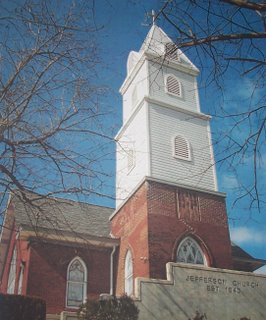 shouldn't get too caught up in programs or programming. Programs can be good, and can indeed point us to larger truths. But it seems to me that "programming" is so yesterday, so Baby Boomer; it's like placing the Adam West TV "Batman" into a post-DKR universe...he may catch a few bad guys, but he'll be largely ineffective in the bigger picture.
Instead of programming (which is entirely supported by the somewhat dated idea of "making disciples"), relationship-building is a far more authentic approach in this 21st century, richly complex, post-postmodern world. In Frank Miller's world, for instance, there are all kinds of programs, for all kinds of purposes, but there are precious few meaningful relationships, which, in Miller's apocalyptic approach, results in the fall of western civilization.
This brings me back to a ministry theme to which I often return...the idea of incarnational ministry. We need to go where the people are, not simply invite them to our building with our latest neato program. We need to eat lunch with them in their homes or their favorite restaurants, not just invite them to our latest potluck supper or spaghetti dinner. We need to get to know the people in our communities by name, so we can give an authentic "hello" in the grocery store...and by vehicle, so that we can wave knowingly when they drive past. Just as important, they need to know us, so they can respond without having to question our motivations. We don't build relationships to make more church members, but simply out of love.
At any rate, with the "year one" business out of the way, it's time for me to look beyond now, and begin to really allow the Spirit to transform our life together and our approach to ministry. Same bat-time, same bat-channel...but hopefully with more bat-wisdom.
Before catching the Greyhound bus for the trip back to Edinboro, I stopped at Eide's Entertainment to purchase something to read on the long trip back to school.
 I had heard a great deal about Frank Miller's The Dark Knight Returns, and was glad to finally have a chance to read this "graphic novel", which had been turning the world of comic books on its ear. I devoured the book on the bus ride, finishing it just as the vehicle pulled into the university lot.
It is not overstating the truth to state that this book changed my life. There are a lot of reasons for this. DKR introduced me to postmodern thinking, to new ways of storytelling, to the idea of "metanarrative" (which has become so important in my theology), and, indirectly, to "film noir", to semiotics, and to host of other ideas. It has been hugely influential; I can hardly imagine American Psycho, Fight Club, or Quentin Tarantino without Miller's DKR (OK, that may be overstating a bit...it's likely, however, that all those creative people were drinking water from the same well as Frank Miller). Beyond all that, it's just a really good story, told exceptionally well.
I was interested, therefore, in Miller's "prequel", called Batman: Year One, which, obviously, told the story of how Batman came to be (as opposed to DKR, which deals with his final days).
In both DKR and Year One, Miller is a patient storyteller who writes about a very patient (though extremely passionate) man. Bruce Wayne doesn't simply decide to become a vigilante and immediately engage criminals in fisticuffs;
 he observes, prepares, learns "the lay of the land", determines the identities of the "power players", and makes proper connections, beginning to build the appropriate relationships he'll need to accomplish his crime-fighting mission.
Not a bad model. That's pretty much what I've been trying to do, and, now, my first year at JUMC is nearly complete. I've spent "year one" trying to observe, prepare, learn "the lay of the land", determine the identities of the "power players", and make proper connections, beginning to build the appropriate relationships I'll need to lead JUMC in accomplishing our disciple-making mission.
I've discovered a lot about the congregation, her history, the area in which God has placed us, and, surprisingly, myself.
Allow me to risk being a mite unorthodox for a moment. I've come to believe that perhaps the Church has it slightly wrong. Our Book of Discipline states that our mission is "to make disciples of Jesus Christ", but, properly speaking, it's the Spirit who makes disciples, not us. The best we can do is to faithfully allow ourselves to be used by the Spirit to do great things...large or small.
We
shouldn't get too caught up in programs or programming. Programs can be good, and can indeed point us to larger truths. But it seems to me that "programming" is so yesterday, so Baby Boomer; it's like placing the Adam West TV "Batman" into a post-DKR universe...he may catch a few bad guys, but he'll be largely ineffective in the bigger picture.Instead of programming (which is entirely supported by the somewhat dated idea of "making disciples"), relationship-building is a far more authentic approach in this 21st century, richly complex, post-postmodern world. In Frank Miller's world, for instance, there are all kinds of programs, for all kinds of purposes, but there are precious few meaningful relationships, which, in Miller's apocalyptic approach, results in the fall of western civilization.
This brings me back to a ministry theme to which I often return...the idea of incarnational ministry. We need to go where the people are, not simply invite them to our building with our latest neato program. We need to eat lunch with them in their homes or their favorite restaurants, not just invite them to our latest potluck supper or spaghetti dinner. We need to get to know the people in our communities by name, so we can give an authentic "hello" in the grocery store...and by vehicle, so that we can wave knowingly when they drive past. Just as important, they need to know us, so they can respond without having to question our motivations. We don't build relationships to make more church members, but simply out of love.
At any rate, with the "year one" business out of the way, it's time for me to look beyond now, and begin to really allow the Spirit to transform our life together and our approach to ministry. Same bat-time, same bat-channel...but hopefully with more bat-wisdom.
Sunday, May 27, 2007
Burning Down The House
"When  the day of Pentecost came, they were all together in one place. Suddenly a sound like the blowing of a violent wind came from heaven and filled the whole house where they were sitting. They saw what seemed to be tongues of fire that separated and came to rest on each of them. All of them were filled with the Holy Spirit and began to speak in other tongues as the Spirit enabled them..."
As we celebrate Pentecost 2007, the famous image of Jesus knocking at the door springs to mind. A reproduction of this famous painting can be found in many churches and in many devotional books. Christians, perhaps evangelical Wesleyans more than others, love the idea of Jesus knocking on the door of a person's heart, asking to be permitted entrance. With a theology based on Revelation 3:20, it is indeed a lovely image, a testament to prevenient grace.
But, on Pentecost, this image spurs other thoughts. For one thing, as Bishop William Willimon has noted, there is no doorknob on the outside; the people inside must open the door in order to answer the call of Jesus (that is certainly a very Wesleyan idea!).
More than that, it just could be that inside that door is not a sinner in need of salvation, but a Church in need of refocusing on her mission. Maybe...just maybe, mind you...it is the Day of Pentecost, and the fires of the Holy Spirit are filling the house. Fire can be warm and pretty, but can also be awfully destructive. Forest fires, which we typically dread, are actually a very normal part of nature's cycle of renewal; you need to burn away the old in order to get new growth.
It could be that Jesus is saying, "Hey, Church; the house is on fire! You'd better get out of there and come out here, with me!"
It could be that Jesus is imploring the Church to get out of the building and into the street, where the mission field can be found.
And so, we have another Pentecost to struggle with Jesus' call to allow the Holy Spirit to set us ablaze with the burning of renewal, and to open the doors of our hearts and our church buildings in order that we embark on the greatest, most important journey we know...the mission to make disciples of Jesus Christ.
May you be blessed with the Spirit of God on this Pentecost.
 the day of Pentecost came, they were all together in one place. Suddenly a sound like the blowing of a violent wind came from heaven and filled the whole house where they were sitting. They saw what seemed to be tongues of fire that separated and came to rest on each of them. All of them were filled with the Holy Spirit and began to speak in other tongues as the Spirit enabled them..."
- Acts 2:1-4 (TNIV)
As we celebrate Pentecost 2007, the famous image of Jesus knocking at the door springs to mind. A reproduction of this famous painting can be found in many churches and in many devotional books. Christians, perhaps evangelical Wesleyans more than others, love the idea of Jesus knocking on the door of a person's heart, asking to be permitted entrance. With a theology based on Revelation 3:20, it is indeed a lovely image, a testament to prevenient grace.
But, on Pentecost, this image spurs other thoughts. For one thing, as Bishop William Willimon has noted, there is no doorknob on the outside; the people inside must open the door in order to answer the call of Jesus (that is certainly a very Wesleyan idea!).
More than that,
 it just could be that inside that door is not a sinner in need of salvation, but a Church in need of refocusing on her mission. Maybe...just maybe, mind you...it is the Day of Pentecost, and the fires of the Holy Spirit are filling the house. Fire can be warm and pretty, but can also be awfully destructive. Forest fires, which we typically dread, are actually a very normal part of nature's cycle of renewal; you need to burn away the old in order to get new growth.
It could be that Jesus is saying, "Hey, Church; the house is on fire! You'd better get out of there and come out here, with me!"
It could be that Jesus is imploring the Church to get out of the building and into the street, where the mission field can be found.
And so, we have another Pentecost to struggle with Jesus' call to allow the Holy Spirit to set us ablaze with the burning of renewal, and to open the doors of our hearts and our church buildings in order that we embark on the greatest, most important journey we know...the mission to make disciples of Jesus Christ.
May you be blessed with the Spirit of God on this Pentecost.
Subscribe to:
Posts (Atom)